



 日本語
日本語  Deutsch
  English
  Español
  Français
  Português
There is a slow chemical war being waged on men, and most of them have no idea it's happening. It doesn't announce itself with symptoms you'd rush to a doctor for. There's no sudden crash, no dramatic event. It's quieter than that — a gradual dimming. Less drive. More fatigue. A body that used to recover fast now takes longer.
Strength that plateaus where it never used to. For millions of men in their 30s, 40s, and 50s, this has become the background noise of daily life, and the explanations offered — stress, aging, lifestyle — never quite add up to the full picture.
A growing body of research points to something far more systemic: the synthetic chemicals lodged in the food chain, the water supply, the air, and the body itself. Microplastics and their chemical companions — particularly endocrine-disrupting compounds — are increasingly implicated in the long-term suppression of testosterone. This is not fringe science. It is published, peer-reviewed, and accelerating. And the projections for 2050 are, to put it plainly, not good.
"A growing body of research points to something far more systemic — synthetic chemicals lodged in the food chain, the water supply, the air, and the body itself."
The Current Trendline: Testosterone Is Already in Decline
Before projecting forward, the baseline needs to be understood. A landmark study published in the Journal of Clinical Endocrinology & Metabolism tracked testosterone levels across American men over several decades and found a population-level decline entirely independent of age. Men in their 40s today carry measurably lower testosterone than men in their 40s did in 1980 — not because they are older, but because the average baseline has dropped. Similar findings have emerged from Danish, Finnish, and British cohort studies.
The magnitude varies by study, but the direction does not. Estimates suggest average total testosterone has declined somewhere between 1% and 2% per year in Western male populations since the early 1980s. Compounded over four decades, that represents a reduction significant enough to shift clinical thresholds. Men who would have been considered hormonally normal in 1985 are borderline-low by today's standards. Men who are borderline-low today may be clinically deficient by 2050 — if the trendline holds.
💡 Did You Know?
A 2017 study published in Human Reproduction Update found that sperm counts among men in Western nations declined by more than 50% between 1973 and 2011 — a parallel collapse running alongside the testosterone data, and likely sharing many of the same chemical drivers.
The question researchers are now racing to answer is: what is driving it? Age-adjusted, body-fat-adjusted, lifestyle-adjusted — the decline persists. Something environmental is in the mix, and the evidence increasingly fingers a class of compounds that were never meant to end up inside a human endocrine system.
Microplastics: What They Are and Why the Body Can't Handle Them
Plastics don't disappear. They fragment — into microplastics (particles under 5mm) and nanoplastics (under 1 micron) — and those fragments accumulate everywhere. In Arctic ice. In the deepest ocean trenches. In human lung tissue, liver tissue, testicles, and bloodstream. A 2024 study published in Environmental Health Perspectives confirmed the presence of microplastic particles in human testicular tissue, with concentrations that correlate inversely with sperm count. The testes, it turns out, are not well-shielded from what circulates in the body.
The concern isn't just the plastic particle itself — it's what the plastic carries and what it does once inside. Two classes of chemicals are central to the testosterone story:
Phthalates — plasticizers added to PVC to make it flexible — are the most studied. They suppress the Leydig cells in the testes, which are the primary factory for testosterone. The evidence from human cohort studies is not subtle: men with higher urinary phthalate metabolite concentrations consistently show lower serum testosterone. BPA, the compound that sparked the original "BPA-free" labeling craze, mimics estrogen and occupies androgen receptors, effectively jamming the signal testosterone is trying to send.
PFAS — perfluoroalkyl substances, the so-called "forever chemicals" — are perhaps the most alarming category for long-range forecasting. They don't break down. They bioaccumulate. They are now detectable in nearly every adult human tested in developed nations, and the International Agency for Research on Cancer classified PFOA (a common PFAS) as carcinogenic in 2023. Their mechanism on testosterone involves disrupting the hypothalamic-pituitary-gonadal (HPG) axis — the hormonal command chain that tells the testes to produce testosterone in the first place.
🌍 Cultural Insight
Why Japan Is Watching This Closely
Japan produces and consumes more plastic per capita than almost any nation. Simultaneously, the country has documented some of the steepest drops in male fertility rates in the developed world over the past 30 years. Japanese researchers are actively studying the relationship between industrial plastic exposure and hormonal decline — making Japan, somewhat inadvertently, a large-scale natural experiment in what chronic low-level chemical exposure does to male reproductive health over generations.
The HPG Axis: The Command Centre Under Siege
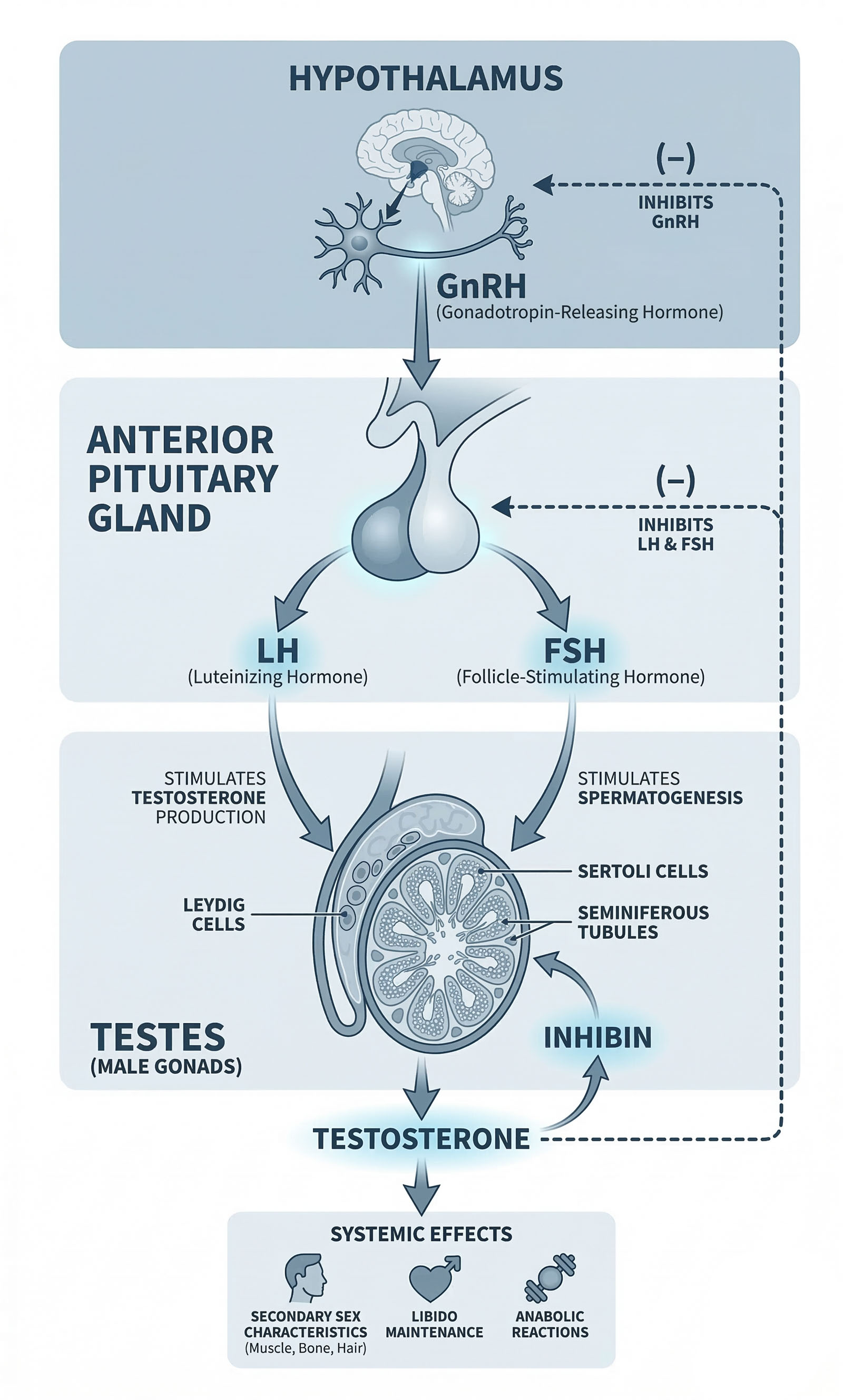
Understanding why this matters at scale requires a basic grasp of how testosterone production is managed. The hypothalamic-pituitary-gonadal axis is the body's hormonal chain of command. The hypothalamus fires pulses of gonadotropin-releasing hormone (GnRH), which prompts the pituitary to release luteinizing hormone (LH), which travels to the testes and tells the Leydig cells to produce testosterone. Interfere with any link in that chain, and production falls.
PFAS compounds have been shown to blunt the LH pulse. Phthalates hit the Leydig cells directly. BPA creates hormonal static at the receptor level. These aren't single-point attacks — they're a coordinated erosion of a system that men have been told is simply "declining with age." The aging explanation isn't wrong; testosterone does fall with age. But the rate of that decline, and the baseline from which it starts, are being chemically accelerated.
What makes this particularly hard to detect is that the impact is cumulative and sub-clinical for years before it becomes symptomatic. A man losing 1.5% of his testosterone per year won't notice it at month six. He may not notice it at year three. By year ten, he notices he's different — slower, less motivated, more prone to gaining fat around the middle — but the cause is invisible. He blames work stress or age, adjusts his expectations, and keeps going.
2050: The Projection Models
Forecasting biological change is not a precise science, but the data trends are consistent enough to model scenarios with reasonable confidence. Several independent research groups — working from environmental exposure data, population cohort studies, and toxicological dose-response curves — have published projections that point in the same direction.
The most conservative models, assuming current exposure levels plateau (which requires significant regulatory intervention that has not yet occurred), project a continued decline of roughly 1% per year in average male testosterone. By 2050, that compounds to a further 25–30% reduction from current levels — on top of the 25–40% already lost since 1980. In clinical terms, this pushes the average testosterone profile of a 40-year-old man in 2050 into a range that today's medicine would treat pharmacologically.
The more aggressive models, accounting for the continued increase in PFAS contamination of groundwater, the expansion of single-use plastics in developing economies, and the bioaccumulation dynamics of forever chemicals over additional decades, suggest the decline could steepen. Some researchers use the term "hormonal poverty" — a state where testosterone levels are technically within a low-normal range, but far below what would optimise male health, cognitive performance, and vitality.
📊 Forecast Snapshot
The 2050 Testosterone Scenario (Conservative Model)
- Average male testosterone already ~25–35% lower than 1980 baseline
- Conservative projection: further 25–30% decline by 2050 vs today
- Estimated result: the average 40-year-old man in 2050 presents at today's clinical low-T threshold
- PFAS body burden in developed-nation men expected to increase unless aggressive remediation begins before 2030
- Sperm count decline trajectory: parallel and consistent, suggesting shared causality
- Aggressive model: "hormonal poverty" becomes population-level normal, not exception
None of this is destiny. It is a projection — a warning shot built from current data. The trajectory can be altered. But altering it requires acknowledging what is happening, which Western public health institutions have been slow to do.
The Regulatory Lag and Why It Matters
The European Union has moved faster than most jurisdictions in restricting phthalates in consumer products and taking steps toward PFAS regulation. The United States has historically lagged, operating under a framework that requires proof of harm after the fact rather than the precautionary principle applied in Europe. This matters enormously for long-range forecasting because PFAS, once in groundwater, takes decades to clear — even after the source is eliminated.
The US Environmental Protection Agency set its first enforceable maximum contaminant levels for several PFAS in drinking water in 2024. It is a meaningful step, but it comes after 70 years of unrestricted use. The chemicals already in the environment, already in the food chain, already in the bodies of men alive today, don't disappear because a limit was set. The body burden built up over decades will continue to exert its effects.
What the Science Hasn't Settled Yet
Intellectual honesty requires acknowledging where the science remains contested. Dose-response relationships for many of these compounds in human populations are difficult to establish with precision. Most of the mechanistic data comes from animal studies at doses higher than typical human exposure. Human epidemiological studies show consistent associations, but association is not the same as proven causation in every case.
There are also researchers who argue the testosterone decline data itself needs scrutiny — that differences in measurement methodology across decades, or population-level increases in obesity (which independently lowers testosterone through aromatisation of testosterone to estrogen in fat tissue), could account for some of the apparent decline without requiring an environmental chemical explanation.
The counterargument: even granting all of that, there is still an unexplained residual decline. The obesity-testosterone relationship is real but cannot account for all of it. The consistent findings across independent research groups in multiple countries, using different methodologies, point to something that transcends measurement artifact.
📋 In Brief
- Testosterone levels in Western men have declined population-wide since the 1980s, independent of age
- Microplastics and endocrine-disrupting chemicals (phthalates, BPA, PFAS) are credibly linked to this decline via multiple biological mechanisms
- PFAS ("forever chemicals") are now detected in virtually all adults in developed nations and don't break down in the body or environment
- Conservative forecasts place the average 40-year-old man in 2050 at today's clinical low-testosterone threshold
- The regulatory response has been slow; PFAS already in groundwater will persist for decades regardless of new limits
- Lifestyle factors (obesity, poor sleep, sedentary behaviour) amplify the chemical drivers — and are themselves partly a downstream consequence of hormonal disruption
- The science is not fully settled, but the direction of evidence across independent global research groups is consistent
The Amplifiers: When Lifestyle and Chemistry Combine
The chemical story doesn't exist in isolation. It interacts with a set of lifestyle factors that are themselves worsening in parallel, creating compounding effects that make the forecast harder to reverse. Obesity independently lowers testosterone through aromatase enzyme activity in adipose tissue — fat tissue converts testosterone into estradiol (an estrogen). As average male body fat has climbed steadily since the 1980s, this metabolic drag on testosterone has grown alongside it.
Poor sleep, which has become a population-level problem in the screen-saturated modern world, suppresses testosterone. Most testosterone is produced during deep sleep — particularly during the first half of the night. Men averaging less than six hours a night show testosterone levels equivalent to men ten years older. Chronic psychological stress elevates cortisol, which is physiologically antagonistic to testosterone production. These are not separate problems. They stack.
A man eating from plastic-packaged processed food, sleeping six hours, carrying excess body fat, under chronic occupational stress, and drinking water with PFAS levels just below the new regulatory limits is experiencing all of these forces simultaneously. The endocrine system doesn't process them one at a time.
What Men Can Actually Do Right Now
None of this is about inducing helplessness. The variables men control directly — sleep, movement, body composition, nutrition quality, stress management — have a documented positive impact on testosterone that is measurable within weeks. Resistance training, in particular, remains one of the most robust testosterone-supporting interventions available without a prescription. The fundamentals work. They don't reverse chemical contamination, but they raise the floor.
On the exposure-reduction side, practical steps exist. Reducing reliance on plastics for food storage and heating — switching to glass or stainless — cuts phthalate and BPA exposure meaningfully. Filtering drinking water (look for certifications that include PFAS removal) addresses a significant vector. Avoiding non-stick cookware with PTFE coatings, particularly older or scratched pans, reduces PFAS ingestion. These are not paranoid measures. They are reasonable responses to known chemistry.
⚡ Quick-Start: Reducing Your Endocrine Disruptor Load
What to Do, What to Ditch
✅ Do
- Store food in glass, stainless steel, or ceramic
- Filter tap water (PFAS-rated filters)
- Prioritise 7–9 hours of sleep, consistently
- Train with weights 3–4× per week
- Choose fresh/whole foods over packaged
- Check personal care products for phthalate-containing fragrances
❌ Don't
- Microwave food in plastic containers
- Use old or scratched non-stick pans
- Drink bottled water from plastic left in heat
- Ignore body composition — visceral fat compounds hormonal disruption
- Assume "BPA-free" means chemical-free (BPS and BPF are similar)
- Dismiss fatigue and low drive as just "getting older"
This is not medical advice. If you suspect low testosterone, speak to a physician for proper testing and evaluation.
The Systemic Question: Who Is Responsible?
This is where the story gets uncomfortable for anyone who believes markets and regulators will sort things out. Plastics are a multi-trillion-dollar global industry. The regulatory capture around chemical safety is well-documented. The timelines for recognising, studying, and then restricting a harmful chemical typically span 20 to 40 years — the same timescale on which biological damage accumulates.
Lead in gasoline. Asbestos in buildings. PCBs in electrical equipment. The pattern is consistent: industry-funded science disputes the evidence, regulatory action lags by decades, and the health consequences accumulate quietly in populations before anyone is legally required to act. There is no reason to believe the PFAS story follows a different arc.
That is not fatalism — it is pattern recognition. It means individual men cannot outsource this problem to regulatory bodies and expect a timely solution. The chemicals already in the environment and in the body are a present reality, not a future risk. Waiting for governments to act before making personal adjustments is an expensive form of patience.
Looking Forward: Research Frontiers for the Next Decade
The most critical open questions in this field will shape what the 2050 forecasts actually look like. Researchers are working on several fronts:
Mixture toxicology — Most studies examine one compound at a time, but human exposure is to hundreds of chemicals simultaneously. The "cocktail effect" of mixed endocrine disruptors may be substantially greater than the sum of its parts, and quantifying that interaction is computationally and methodologically complex.
Epigenetic transmission — There is emerging evidence that endocrine disruption can alter gene expression in ways that are passed to subsequent generations. Sons born to men with high phthalate burdens may start life with a different hormonal baseline than their fathers did. If confirmed at population scale, this changes the forecast models significantly — the decline may not simply continue at a constant rate but could steepen across generations.
Mitigation pharmacology — Research into compounds that might help the body clear or neutralise endocrine disruptors is active. Some natural compounds (sulforaphane from broccoli, for instance) have shown promise in early data as inducers of detoxification pathways. This is not yet a protocol, but it is a serious research direction.
Frequently Asked Questions
The Longer Arc
There is something worth sitting with in all of this. The testosterone decline is not just a reproductive statistic — it maps onto broader changes in male vitality, mental health, motivation, and physical capacity that show up in population data as well. Rates of depression and anxiety in men have climbed. Competitive drive and risk-taking in younger male cohorts have shifted. None of this has a single cause, and the chemical hypothesis doesn't claim to explain everything. But it is part of the picture, and it has been underweighted.
Men in 2026 are making decisions in a world their fathers and grandfathers didn't live in — one where the daily chemical environment quietly works against the hormonal system that drives everything from physical energy and libido to confidence and competitive instinct. Knowing that isn't cause for alarm. It is cause for intelligence.
The forecast for 2050 is not fixed. It is where the current trajectory leads if nothing changes. Trajectories change when enough people understand what's happening and start making different decisions — individually and collectively. The science exists. The data is clear enough. What comes next depends on what men do with it.
Disclaimer: The articles and information provided by Genital Size are for informational and educational purposes only. This content is not intended to be a substitute for professional medical advice, diagnosis, or treatment. Always seek the advice of your physician or another qualified health provider with any questions you may have regarding a medical condition.


