


 English
  Deutsch
  Español
  Français
When a man steps beyond the paved world—into forest, desert, mountain, or backcountry—something instinctive stirs. It’s not nostalgia and it’s not some fantasy of living off-grid forever. It’s the quiet reminder that every generation of men before us was expected to solve problems with their own hands. Tools weren’t luxuries. They were extensions of responsibility.
Today, most men live in cities, carry smartphones, and rely on systems built by others. Yet the urge to carry reliable gear—real gear—has never disappeared. A man doesn’t need to be a homesteader or a wilderness guide to understand the value of being prepared. Life throws curveballs, from power outages to broken-down vehicles to unexpected storms. A man carries tools not because he expects chaos, but because he respects himself enough to meet it head-on when it arrives.
So here it is: ten tools every man should have within reach. Some belong in your truck, some in your daypack, and some right on your belt. You won’t need all of them all the time. But the man who carries nothing is the man who’s betting everything on luck—and luck is the least dependable tool of all.
This isn’t a list for hobbyists. This is a list for men who take preparedness seriously.
- Do: Pack a fixed-blade, multi-tool, fire tool, and water filter first.
- Do: Practice using each item once at home.
- Don't: Rely on a single method for fire or water.
- Don't: Carry heavy gear you won’t use—prioritize utility.
1. A Fixed-Blade Knife: The Backbone of Any Kit
A man’s knife says more about him than almost any item he carries. A good fixed-blade isn’t ornamental and it isn’t a fashion piece. It’s a practical, uncompromising tool for cutting rope, making kindling, clearing brush, preparing food, and handling the hundred small tasks that unfold when you’re far from home.
Why fixed-blade over folding? Reliability. A folding knife can fail at the hinge. A full-tang fixed blade is essentially unbreakable when used properly. Choose something 4–6 inches, high-carbon or premium stainless, with a sheath that won’t fall apart when the weather turns ugly.
A knife isn’t about “looking tough.” It’s about capability. Once you’ve carried a real one, you’ll wonder why you tolerated anything less.
2. A Multi-Tool: The Modern Man’s Utility Belt
A multi-tool is the Swiss Army knife redefined for the modern world. Pliers, screwdrivers, scissors, small blades, files, saws—packed into one compact frame. While a fixed-blade is your primary cutting tool, a multi-tool fills every gap.
Think of the scenarios:
-
Tighten a loose bolt on your gear
-
Crimp a broken wire on your truck battery
-
Cut fishing line
-
Fix a zipper that fails at the worst possible moment
A multi-tool keeps small problems from becoming emergencies. And in the field, that difference matters.
3. A Reliable Fire Starter: Because Fire is Life
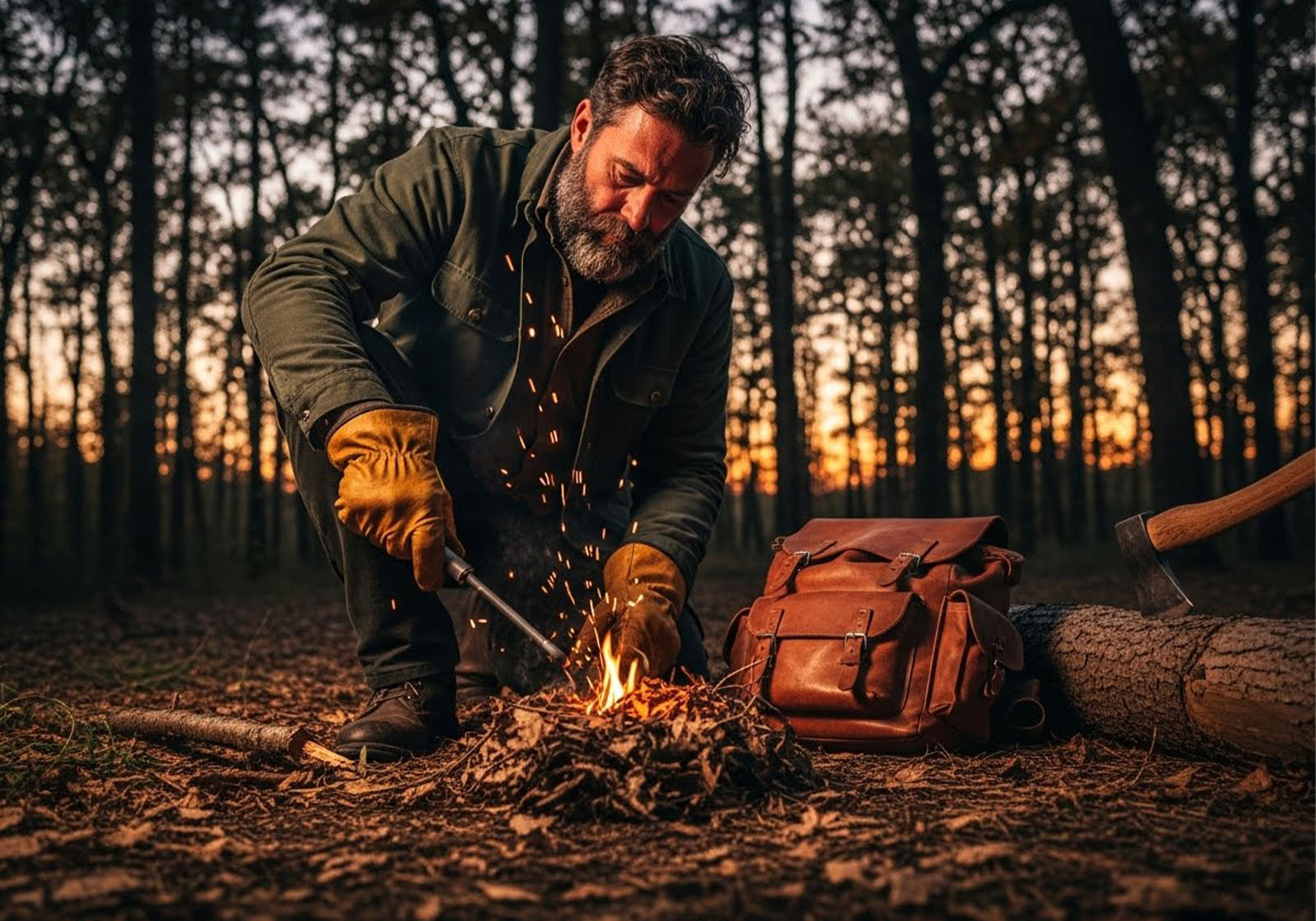
Any man who’s spent a cold night outside without fire will never underestimate it again. Fire is warmth, safety, signaling, morale, and the ability to purify water or cook food. In survival stories—real ones—not fictionalized drama—men don’t perish because of wolves or villains. They perish because they couldn’t stay warm.
You want three types of fire starters:
-
Ferro rod—reliable even when wet
-
Butane lighter—quick and effortless
-
Stormproof matches—the backup to your backup
A man who understands redundancy understands survival. Fire isn’t optional. Fire is foundational.
4. A Compact Flashlight or Headlamp: Illumination on Demand
Darkness is an equalizer. When the sun goes down, even familiar terrain turns alien. A high-quality flashlight or headlamp is one of the most underrated survival items men overlook.
Look for:
-
300–1000 lumens
-
Waterproofing
-
A low-power mode that preserves battery
-
USB-rechargeable or dual-fuel capability
A headlamp keeps your hands free—an advantage during repairs, hikes, or emergencies. A flashlight, on the other hand, offers power and precision. Some men carry both. Smart men do.
5. A Durable Water Filter: Because Thirst Outpaces Everything
In survival situations, you can go days without food, but dehydration will break you fast. Water is heavy to carry, unpredictable in the wild, and unsafe more often than not.
A compact filter like a pump system, straw-style, or bag-squeeze model ensures you can drink from streams, lakes, or even muddy puddles if necessary.
A man doesn’t rely on hope when it comes to water. He prepares.
6. A First-Aid Kit: The Tool Every Man Ignores Until He Needs It
A first-aid kit isn’t about being soft. It’s about being smart. Whether it’s a deep cut from cutting branches, a sprained ankle on uneven ground, or a burn from fire prep, the outdoors doesn’t care how tough you are.
At minimum, carry:
-
Gauze and tape
-
Antiseptic wipes
-
Alcohol pads
-
Bandages
-
Tweezers
-
Pain medication
-
A tourniquet (if you’re remote or hunting)
A small injury can turn serious if ignored. The prepared man knows that bleeding out from a simple mistake isn’t “rugged.” It’s preventable.
7. A Space Blanket or Compact Shelter: You’re Not Invincible
Exposure is one of the top killers in the wild, far above predators or disaster scenarios. Weather changes fast. A clear afternoon can become a freezing night after sundown.
A mylar emergency blanket, compact bivvy, or lightweight tarp can save your life if everything goes wrong at once.
It weighs almost nothing, fits anywhere, and buys you time—time to think, time to warm up, time to survive.
8. Paracord: The Rope That Does Everything
Paracord is one of the most versatile tools ever created. Shelter building, securing gear, fashioning snares, repairing broken backpack straps, replacing shoelaces—it’s endless.
Carry at least 25–50 feet. More if you’re hiking or camping in unfamiliar terrain.
Simple. Light. Unfailingly useful. Real men over the centuries have relied on rope. This is the modern version.
Nearly half of outdoor rescues are triggered by lost or stranded hikers with depleted batteries—carry at least one high-capacity power bank and a phone-power strategy.
9. A Rugged Power Bank: Because Even the Strongest Man Needs Communication
We may love the idea of disappearing into the mountains with zero technology. But let’s be honest: communication saves lives. A dead phone is useless during emergencies, and even GPS units can fail or drain faster than expected.
A power bank keeps your devices alive—not for scrolling, not for entertainment, but for navigation, weather checks, emergency calls, and signal apps.
Survival isn’t a fantasy. It’s a system. And technology, used responsibly, is part of it.
10. A Compact Folding Saw or Hatchet: Small Tools, Big Impact
A folding saw or hatchet gives you the muscle that a knife alone can’t. Cutting firewood, clearing branches, building a windbreak—these tasks require force. A hatchet excels at chopping. A folding saw excels at precision and efficiency. Pick one based on your environment and personal preference.
A man isn’t expected to carry a full-size axe or a lumberjack kit. But he should carry something that gives him leverage. Strength isn’t only in your body. It’s in the tools you choose.
Why These Ten?
Survival isn’t about fantasy scenarios or doomsday obsessions. It’s about responsibility and readiness. These ten tools form the backbone of a practical, real-world survival system that fits into almost any bag. Each one solves a specific category of human need:
-
Cutting (knife, multi-tool, saw/hatchet)
-
Heat and safety (fire starter, space blanket)
-
Navigation and visibility (flashlight/headlamp)
-
Hydration (water filter)
-
Health (first-aid kit)
-
Communication and reliability (power bank)
-
Structural capability (paracord)
When a man carries these ten, he’s not preparing for the end of the world. He’s simply ensuring he has the tools to protect himself and anyone with him—whether a friend, a son, a daughter, or a woman he cares about.
Preparedness is a masculine principle because it’s built on responsibility. Men aren’t defined by how loudly they talk about strength. They’re defined by whether they’re ready when strength is required.
Tool at-a-glance
| Tool | Estimated Weight | Carry Location | Primary Use |
|---|---|---|---|
| Fixed-blade knife | 150–300 g | Belt sheath | Cutting, shelter, food prep |
| Multi-tool | 150–250 g | Pocket/pack | Repairs, trimming |
| Ferro rod + lighter | 50–120 g | Pouch | Fire starting |
| Water filter (straw/bottle) | 150–350 g | Side pocket | Safe drinking water |
The Mindset Behind the Gear
Tools alone won’t save a man. They’re only as effective as the skills and mindset behind them.
Modern society isn’t designed to cultivate ruggedness. But men who choose to build resilience—physical, mental, and practical—stand out. They’re steady when others panic. They’re calm when others freeze. They act when others wait for someone else to fix the problem.
Carrying survival tools isn’t about paranoia. It’s about self-reliance. And that’s a value worth holding onto in a world that increasingly discourages it.
Common Questions
Printable Gear Checklist
- Fixed-blade knife + sheath
- Multi-tool
- Ferro rod + lighter + storm matches
- Headlamp or compact flashlight
- Compact water filter (straw or pump)
- First-aid kit
- Space blanket / compact shelter
- 25–50 ft paracord
- Rugged power bank
- Folding saw or hatchet
Tip: Print this page or save as PDF and tuck a copy into your glovebox or pack.
The Man Who Prepares, Leads
Every generation produces two types of men:
-
Those who assume everything will go smoothly
-
And those who quietly prepare for the moments that won’t
The world doesn’t reward laziness or complacency. Men don’t need to be perfect. But they should be capable. They should be useful. They should be ready.
These survival tools aren’t gear for your shelf. They’re instruments of readiness—extensions of a mindset that says: “If something goes wrong, I won’t stand helpless.”
A man who carries tools is a man who carries responsibility. And in a culture where excuses are common, that alone sets you apart.
If you're building a life defined by strength, competence, and legacy, this is where it begins.
Disclaimer: The articles and information provided by Genital Size are for informational and educational purposes only. This content is not intended to be a substitute for professional medical advice, diagnosis, or treatment. Always seek the advice of your physician or another qualified health provider with any questions you may have regarding a medical condition.