



 日本語
日本語  Deutsch
  English
  Español
  Français
  Português
Nobody talks about this at the gym. Nobody brings it up over beers. But the two biggest threats to a man's intimate health aren't what most men assume — they aren't age, they aren't diet, and they definitely aren't the things late-night infomercials want to sell you a fix for. The real culprits are hiding in plain sight: the hours you're not sleeping, and the pressure you can't seem to shake.
Sleep deprivation and chronic stress are doing a number on men's bodies in ways that go far beyond feeling tired or wound up. They cut into hormone production, drain confidence, dull desire, and quietly chip away at the sexual self-image that most men work hard to maintain. The frustrating part? Most men never connect those dots. They chalk it up to a bad week, a dry spell, or just "getting older." Meanwhile, the cause is something they could actually do something about.
This is the straight story — no fluff, no shame, no miracle cures. Just what's actually happening inside your body when you're running on empty and running hot.
The Testosterone Connection Nobody Warned You About
Here's the biology stripped down to brass tacks: testosterone is the engine of male sexual function. It drives libido, supports erections, fuels confidence, and even affects how emotionally present you are with a partner. And it doesn't run on willpower — it runs on sleep.
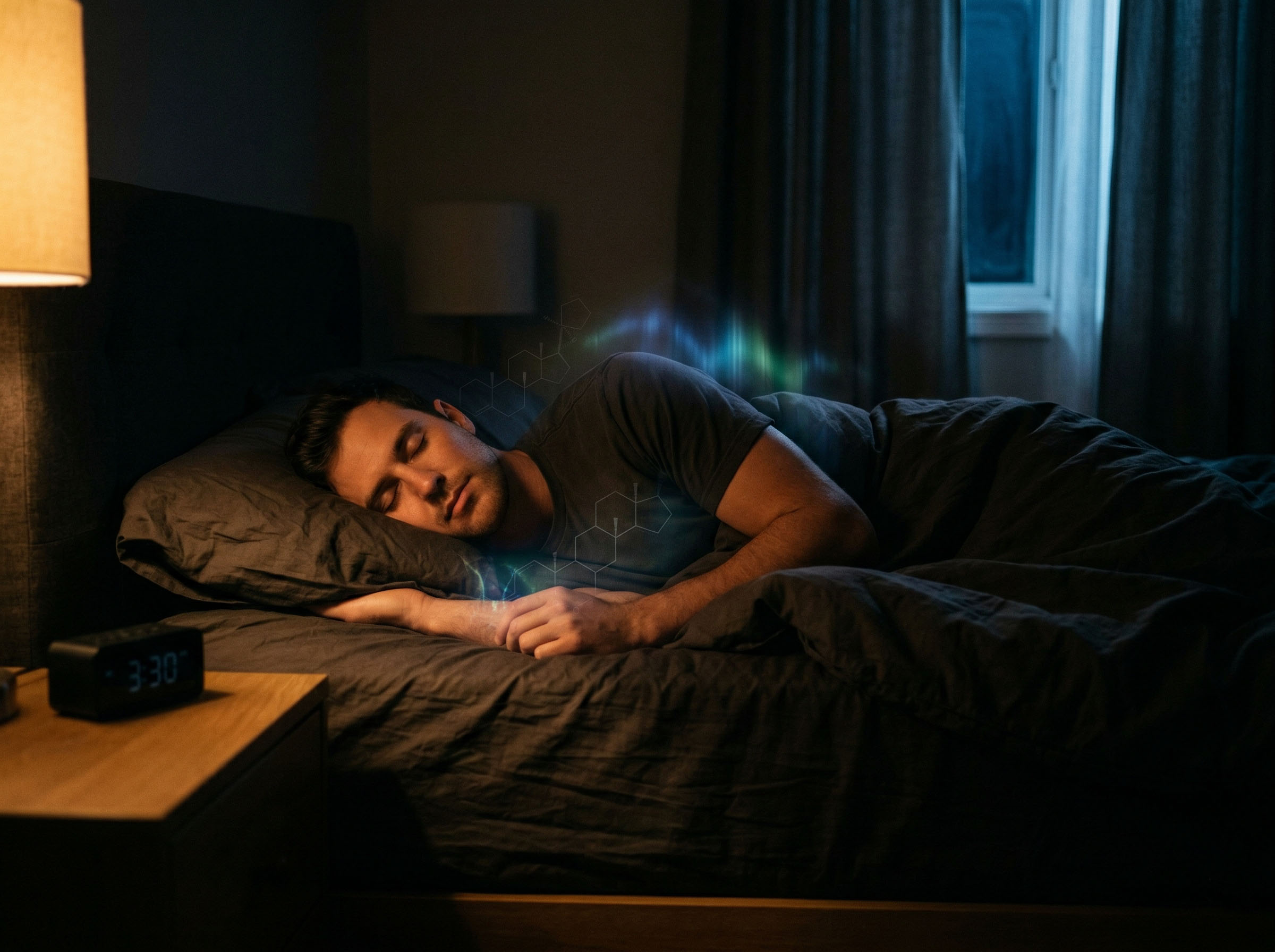
The majority of your daily testosterone is produced during sleep, specifically during the deep, slow-wave stages. Research has consistently shown that men who sleep fewer than six hours per night have measurably lower testosterone levels than those who get seven to nine hours. One landmark study published in the Journal of the American Medical Association found that a week of sleeping just five hours per night reduced testosterone levels in young, healthy men by 10 to 15 percent. That's roughly equivalent to aging ten to fifteen years in terms of hormonal impact — in just one week.
Think about that the next time you're burning midnight oil on a project, scrolling your phone until 1 AM, or convincing yourself you'll "catch up on sleep this weekend." Your endocrine system doesn't work on a binge-and-recover schedule. It needs consistent nightly input to keep producing at full capacity.
Men produce roughly 95% of their testosterone during sleep. Peak production occurs between 8 AM and 10 AM — but only if you've had adequate sleep the night before. Cutting sleep to five hours or less for just one week can drop testosterone levels by as much as 15%.
What Stress Hormones Are Doing Downstream
Now layer chronic stress on top of poor sleep, and you have a compounding problem that most men never fully recognize as a system in conflict with itself.
When you're under sustained pressure — work deadlines, financial strain, relationship tension, the constant noise of modern life — your body releases cortisol. That's not inherently a bad thing. Cortisol is your built-in emergency response system. In short bursts, it's useful. It sharpens focus, mobilizes energy, and gets you through a crisis.
The problem is that cortisol and testosterone are locked in a hormonal tug-of-war. When cortisol stays elevated for extended periods, testosterone drops in response. Your body, from a survival standpoint, isn't interested in reproduction when it thinks you're under threat. It redirects resources. Sex drive? Optional. Stress management? Priority one.
That's not weakness. That's evolutionary biology doing exactly what it was designed to do. The catch is that your nervous system can't tell the difference between a genuine physical threat and a brutal Q4 earnings review. Stress is stress, and the hormonal response is the same.
The Performance Anxiety Spiral — And How It Starts
Here's where things get psychologically messy. The physical effects of sleep loss and stress are real enough on their own. But men are also wired to interpret performance in a self-referential way. One bad night — where desire is low, response is slow, or connection feels hollow — can plant a seed of doubt that grows into something far more stubborn than the original cause.
Call it the performance anxiety spiral. It usually unfolds like this: stress or exhaustion causes a dip in sexual desire or function. The man notices. He starts watching himself during intimacy rather than being present in it. The self-monitoring creates mental noise. The mental noise creates more tension. The tension feeds the very problem he's worried about. And now the anxiety has become its own cause, independent of the original stressor.
This is one of the most common patterns that men's health practitioners see, and it's almost entirely preventable when men understand what's actually triggering the cycle in the first place. Sleep and stress are usually at the root — not anatomy, not age, not something fundamentally broken.
The Performance Anxiety Spiral Is a Learned Response
One bad experience caused by external stress can become a self-sustaining cycle. The moment a man starts mentally monitoring his own performance during intimacy, he shifts from participant to spectator — and that mental distance is often more disruptive than whatever originally triggered the problem. Understanding the root cause breaks the loop.
Real Men, Real Experiences
James, 38, a site manager in the construction industry, put it plainly: "I thought I was just getting older. Turns out I was sleeping five hours a night for two years straight and running on adrenaline. When I actually fixed my sleep, it was like someone turned a switch back on. Everything changed — mood, energy, and yeah, everything in the bedroom too."
That's not an unusual story. It's repeated across men in demanding careers, fathers juggling young children and careers, men going through major life transitions. The common thread isn't weakness — it's simply that nobody ever told them how directly their nightly habits were shaping their hormonal reality.
Ryan, 44, a firefighter, described a different angle: "The shift work destroyed me. I wasn't connecting the dots — I thought the stress of the job was just normal and I had to push through. My wife finally said something. It was uncomfortable but she was right. My sleep schedule was completely wrecked and it was affecting everything."
The willingness to actually look at the problem — not dismiss it, not medicate around it — is what separates men who recover from this pattern and those who don't.
The Sleep-Stress Cycle: Why One Makes the Other Worse
There's a particularly nasty feedback loop that men tend to underestimate: stress disrupts sleep, and poor sleep amplifies stress. It's not a coincidence — it's a physiological mechanism.
When cortisol stays elevated into the evening, it suppresses melatonin, the hormone your body uses to signal that it's time to wind down. You lie in bed, mind racing, body tense, unable to cross the threshold into real rest. You get up tired. Your stress tolerance drops. The same situation that would have been manageable on eight hours feels impossible on five. You're more reactive, less focused, more easily overwhelmed. And that emotional state doesn't stay at the office — it follows you home.
Sleep deprivation also impairs emotional regulation in measurable ways. The prefrontal cortex — the part of your brain responsible for patience, judgment, and empathy — is disproportionately affected by poor sleep. What this means in practical terms: you're shorter with your partner, less emotionally available, and less likely to initiate or respond to intimacy. The relational friction that results creates more stress. Which further disrupts sleep. And on it goes.
Reference Table
How Sleep & Stress Affect Male Intimate Health
Sexual Self-Image: The Invisible Cost
Beyond the hormones and the physiology, there's something harder to measure but just as important: how a man sees himself as a sexual being. Sexual self-image isn't vanity — it's the quiet, underlying confidence that shapes how a man approaches intimacy, how present he is in it, and how he rebounds when things don't go to plan.
Chronic stress and sleep deprivation erode that self-image over time. Not in one dramatic moment, but gradually. A man who's constantly exhausted starts to see intimacy as another demand on a depleted system. He stops initiating. He disengages before the conversation even starts. He might even begin to avoid situations where intimacy is a possibility, because the anticipation of "what if it goes wrong" is too uncomfortable to sit with.
That avoidance pattern compounds the problem relationally. Partners notice withdrawal, even when they don't know its source. The distance grows. And now there's a relational problem layered on top of a biological one — each feeding the other.
The Warrior's Rest: Ancient Cultures Took Sleep Seriously
In ancient Japan, samurai followed strict sleep disciplines as part of their warrior code. Rest wasn't considered passive — it was preparation. Roman legions built structured rest periods into campaign routines, recognizing that a depleted soldier was a liability.
The modern masculinity myth that equates less sleep with more toughness inverts a principle that successful warriors across history understood instinctively: recovery is part of performance, not separate from it.
History & Culture / Male PerformanceCommunication: The Part Most Men Skip
A man's intimate health doesn't exist in isolation — it lives in relationship. And one of the most concrete, actionable things a man can do when stress or fatigue is affecting his sex life is talk about it. Not in an overly clinical, heavily processed way. Just honestly.
"I've been running on empty and I know it's affecting me" is a complete sentence. It's direct. It explains what's happening without catastrophizing it. Most women respond to that kind of honesty far better than the silence and avoidance that usually replaces it.
Silence has a way of filling itself in with the worst possible interpretations. A partner who doesn't know what's going on is left to wonder whether the problem is about them, whether something has changed, whether the relationship is in trouble. That uncertainty creates its own pressure, which adds to the man's stress, which — you see how this spirals.
One simple conversation, delivered without shame or elaborate explanation, can short-circuit weeks of relational friction. It also builds something: the trust that comes from a man being willing to be straight with his partner about what's actually going on. That's not weakness. That's the kind of groundedness most women genuinely respect.
The Sleep–Stress–Performance Feedback Loop
Chronic Stress or Sleep Shortage
Work pressure, financial load, shift work, late nights — cortisol rises, melatonin drops, sleep quality deteriorates.
Testosterone Suppression
High cortisol blocks testosterone synthesis. Reduced deep sleep cuts hormonal production. Libido, energy, and mood drop.
Intimate Performance Disrupted
Desire fades, response slows, connection feels muted. The gap between expectation and reality creates self-awareness and doubt.
Anxiety & Self-Monitoring
The man becomes a spectator of his own experience. Mental noise replaces presence. Performance anxiety becomes a secondary cause independent of the first.
Avoidance & Relational Friction
Man withdraws from intimacy. Partner senses the distance. Relational tension increases stress. The loop restarts from step one — often harder to exit than it was to enter.
Breaking the loop: Intervention is most effective at step one — address the sleep deficit and the stress load before the anxiety layer becomes self-sustaining. The earlier the recognition, the simpler the recovery.
What Recovery Actually Looks Like
Here's the good news — and it's genuinely good: these are reversible conditions. The body responds well when given what it actually needs. That's the honest, straightforward reality. You're not fighting against something permanent. You're dealing with a system that's been running on insufficient input, and systems like that respond to change.
Sleep hygiene isn't a soft topic — it's infrastructure. Consistent sleep and wake times train your circadian rhythm. A dark, cool room significantly improves sleep quality. Cutting alcohol in the evening — even though it feels like a wind-down — reduces REM sleep and fragments the deep stages where hormonal production happens. Screens before bed delay melatonin release. These aren't opinions; they're biology.
Stress management, similarly, isn't about eliminating pressure — it's about managing your physiological response to it. Physical training is genuinely one of the most effective cortisol regulators available. Consistent exercise not only reduces baseline cortisol levels but directly supports testosterone production. It also rebuilds the physical confidence and self-image that stress tends to wear down.
Deliberate recovery — whether that's structured downtime, time outdoors, or anything that genuinely disengages your stress response — isn't a luxury. For men under sustained pressure, it's a maintenance requirement.
The Pressure Men Put on Themselves — and Why It Needs to Change
There's a version of masculinity that treats any crack in performance as a character flaw. That version is not only unhelpful — it actively makes things worse. Men who believe they should be immune to fatigue, impervious to stress, and always "on" are not stronger for that belief. They're less equipped to handle the natural human reality that the body has limits and those limits affect every system, including the sexual one.
The men who actually perform well over the long haul — in their careers, their relationships, their physical lives — are the ones who take recovery seriously. They're not soft about it. They're strategic. They understand that running a depleted system is inefficient and that investing in recovery is how you stay capable over time.
That framing might help some men make the shift. This isn't about coddling yourself. It's about operating like a machine that requires maintenance rather than one that should just run forever without it. Because machines that don't get maintained don't fail gradually. They break down.
- Most testosterone is produced during deep sleep — chronic sleep loss measurably reduces it.
- Cortisol (your stress hormone) and testosterone operate in opposition. When one rises, the other tends to fall.
- The performance anxiety spiral often starts with a physical cause (fatigue, stress) and becomes a psychological one.
- Sexual self-image erodes gradually under sustained pressure — recognizing the pattern early is the most effective intervention.
- Honest communication with a partner short-circuits the relational fallout that silence creates.
- Consistent sleep, regular exercise, and deliberate recovery are not optional for men under sustained load — they are the maintenance plan.
Common Questions About Sleep, Stress & Intimate Health
The Bottom Line
There's nothing complicated about this, once you see it clearly. Your body is not a separate system from your sex life — it is your sex life. How you sleep, how you manage the pressure you're under, how you recover from the demands of your day — all of it flows directly into how you show up in your most intimate moments.
Men who ignore that connection aren't tougher for it. They're just operating with a blind spot that costs them more than they realize. Closing that blind spot doesn't require anything radical. It requires honesty — about how depleted you actually are, about what's actually driving the problem, and about what it would take to fix it.
Sleep isn't a weakness. Recovery isn't optional. And asking for a conversation about what's going on is one of the most confident things a man can do. The men who have figured that out are the ones performing well in every sense of the word — long after the ones grinding on empty have worn themselves down.
Start with sleep. Deal with the stress. Be straight with your partner. The rest tends to follow.
Disclaimer: The articles and information provided by Genital Size are for informational and educational purposes only. This content is not intended to be a substitute for professional medical advice, diagnosis, or treatment. Always seek the advice of your physician or another qualified health provider with any questions you may have regarding a medical condition.


