


 日本語
日本語  Deutsch
  English
  Español
  Français
  Português
There is a muscle group sitting at the base of your torso that controls your bladder, supports your spine, influences the quality of your erections, and plays a direct role in how sex feels — and the odds are extremely good that you have never once trained it on purpose.
The pelvic floor. You've probably heard the term. You've probably associated it with something your mother or a pregnant woman was told to do. That association is exactly the problem, and it's costing men real performance.
Forget the clinical framing for a minute. Think of it this way: if someone told you there was a group of muscles that, when weak, quietly degraded your sexual function, your bladder control, your lower back stability, and your ability to maintain power through your hips during heavy lifts — and that you could strengthen it in ten minutes a day — you'd do it. The reason men aren't doing it is simple: nobody told them it was theirs to train.
It is. And it's time to treat it that way.
In Brief
What this article covers:
- Why the pelvic floor is a critical performance muscle — not a rehab tool
- The anatomy that actually controls erection quality, ejaculation, and urinary control
- How training this muscle group affects stamina and sensation
- The right way to train it — and the surprisingly common mistakes
- Why most men ignore this until something goes wrong
What the Pelvic Floor Actually Is
Strip away the medical jargon and you're looking at a hammock of layered muscles and connective tissue that stretches from your pubic bone at the front to your tailbone at the back, spanning side to side between your sit bones. It forms the base of what sports scientists now call the "deep core" — the inner cylinder of muscles that includes the diaphragm above, the multifidus behind, and the transverse abdominis wrapping around. The pelvic floor is the floor of this system.
In men, this muscle group has several distinct layers, each with its own job. The deepest layer — the levator ani — is the workhorse. It includes the pubococcygeus, the iliococcygeus, and the puborectalis muscles. Closer to the surface, the ischiocavernosus and bulbospongiosus muscles wrap around the base of the penis and play a direct mechanical role in erections and ejaculation.
These aren't obscure anatomical trivia. These are the muscles that literally pump blood into erectile tissue and squeeze during orgasm. When they're undertrained, everything downstream — sensation, control, intensity — suffers for it.
Reference Table
The Performance Connection Men Miss
Here's where it gets real. The pelvic floor isn't just about avoiding the embarrassing dribble after a sneeze in your fifties. It's a performance tissue. When it functions well, it acts as a force transfer platform — meaning power generated in your legs and hips travels up through a stable pelvis and into your torso efficiently. When it doesn't, that chain leaks.
Powerlifters and sprinters have known for years that hip stability matters. What the research is now making clearer is that a weak pelvic floor quietly degrades that stability from the inside out. You can have strong glutes and hamstrings and still have a compromised force transfer chain if the floor of your pelvis can't hold tension under load.
In terms of sexual performance, the mechanical picture is straightforward. The ischiocavernosus muscle physically compresses the crura of the penis — the internal root of the erectile bodies. When this muscle contracts with force, it drives blood pressure in the corpora cavernosa higher than systemic blood pressure, which is what makes a fully rigid erection possible. A weak or undertrained ischiocavernosus means erection quality is literally limited by muscular output, not just vascular supply.
The bulbospongiosus does the rhythmic contracting during ejaculation. Stronger contractions produce more intense orgasms and greater ejaculatory distance — metrics most men would prefer to trend in the right direction.
"The ischiocavernosus compresses the root of the penis during arousal. When this muscle is strong, it drives blood pressure in erectile tissue above systemic levels. Erection rigidity is, in part, a muscular output problem."
— Adrian Lowe, on the mechanics of male sexual function
Why Men Don't Train It — And Why That Has to Change
The cultural messaging around pelvic floor training has almost exclusively targeted women, particularly during pregnancy and postpartum recovery. That's not wrong — women genuinely need it. But the result is that the words "pelvic floor" trigger an immediate mental exit in most men. It gets filed under "not my department."
This is a marketing failure, not a medical reality. Men have a pelvic floor. Men's pelvic floors weaken with age, sedentary behavior, chronic sitting, and heavy training without proper bracing mechanics. The consequences — gradual loss of erectile firmness, reduced ejaculatory force, the occasional post-void dribble, and subtle hip instability — don't announce themselves loudly. They just quietly accumulate.
There's also the ego factor. Going to a physical therapist and being handed a pamphlet about Kegel exercises feels, to most men, like the opposite of what strength training is supposed to be. But consider this: the same sports medicine clinics that rehabilitate elite athletes, the same performance coaches working with professional fighters, they all assess pelvic floor function. It's on the checklist. It's not a soft topic. It's a tissue that either performs or doesn't.
Cultural Insight
Ancient Practice, Modern Science
In traditional Chinese medicine and Taoist sexual health practices dating back over 2,000 years, deliberate contraction of the perineal muscles was considered essential to male vitality and longevity — referred to as "locking the gate" during the practice of retained ejaculation.
Ancient Indian texts, including certain branches of Hatha Yoga, describe Mula Bandha — a root lock engaging exactly the muscles of the pelvic floor — as a foundational energy practice for men.
What modern exercise physiology now confirms with EMG studies and MRI, these traditions mapped empirically centuries ago: the muscles at the base of the pelvis are central to male sexual power and physical stability.
The Science of Sensation
Men who strengthen their pelvic floor consistently report heightened sexual sensation, and the mechanism isn't mysterious. Greater neuromuscular awareness of a region — achieved through targeted training — increases the density of neural signaling from that area. You become more conscious of what's happening, which feeds back into subjective experience.
There's also the direct mechanical effect. Stronger contractions during orgasm mean more intense muscular activity, which registers as more powerful physical sensation. Think of it the way you'd think of any other physical skill: a trained muscle performs at a higher level and generates more output than an untrained one. That principle doesn't stop applying just because the muscle in question is under your pelvis.
Research in men's pelvic health has also linked pelvic floor training to improvements in premature ejaculation — not through some psychological trick, but through actual voluntary control. The pudendal nerve, which controls both sensation and voluntary muscle function in the pelvic region, becomes better regulated with consistent training. Men report being able to modulate arousal more precisely, which translates directly into greater control over ejaculatory timing.
⚡ Did You Know?
A peer-reviewed study published in Therapeutic Advances in Urology found that pelvic floor muscle training resolved premature ejaculation in 61% of men — compared to pharmaceutical intervention, which showed improvement in around 55%. That's not a niche finding. That's a training variable that outperforms a pill.
Stamina: The Long Game
Stamina in bed isn't just cardiovascular. Anyone who has been mid-session and felt the pelvic muscles begin to fatigue knows exactly what's being described here. The deep pelvic muscles are endurance tissues — they need both strength and the ability to sustain tension over time without fatiguing.
Most men have never trained these muscles at all. Which means they fatigue quickly, which means performance degrades faster than it should. The solution isn't complicated. It's the same solution that applies to every other muscle group that underperforms: consistent, progressive training.
The good news is that pelvic floor muscles respond quickly. Because most men start from an essentially untrained baseline, early gains come fast — typically within four to six weeks of consistent work. The muscle group is also small, which means recovery is rapid. You can train it daily without overtraining risk, something you absolutely cannot say about your quads or your back.
Quick-Start Guide
Train Your Pelvic Floor: Where to Begin
The Basics
- Find the muscles: stop urination mid-flow — those are them
- Slow hold: contract and hold 5–10 seconds, release fully
- Fast twitch: rapid contract-release, 1 second each
- Start with 3 sets of 10 reps each type, once daily
- Progress to 3× daily as control improves
Do's
- Breathe normally throughout
- Release fully between contractions
- Integrate during squats and deadlifts (brace at the bottom)
- Train sitting, standing, and lying — vary positions
- Be consistent — 4–6 weeks for measurable change
Don'ts
- Don't hold your breath or tense your glutes/abs
- Don't train by repeatedly stopping urine — this is for finding the muscles only
- Don't assume more is always better — full release matters as much as contraction
- Don't ignore tightness — an overtight pelvic floor causes its own problems
The Overtight Floor: A Problem Nobody Talks About
There's a flip side that rarely gets addressed in fitness circles. Not every man has a weak pelvic floor. Some men — particularly those who have been under prolonged stress, who sit for hours daily, or who engage in heavy lifting with poor bracing mechanics — develop a hypertonic, or overtight, pelvic floor.
A pelvic floor that can't fully relax is just as dysfunctional as one that can't adequately contract. Symptoms include chronic tension in the perineum or lower abdomen, pain with certain seated positions, and paradoxically, difficulties with both urination and sexual function. A muscle locked in constant tension doesn't perform well. It fatigues faster, conducts force poorly, and can contribute to referred pain in the lower back and hips.
This is one reason why pelvic floor training isn't simply about doing more Kegels. The ability to fully and consciously relax these muscles is equally important to developing strength. Yoga, deliberate diaphragmatic breathing, and targeted stretches that open the hip and perineal region are all legitimate tools for men dealing with chronic pelvic tension. This isn't fragile territory. It's maintenance.
Pelvic Floor and the Aging Man
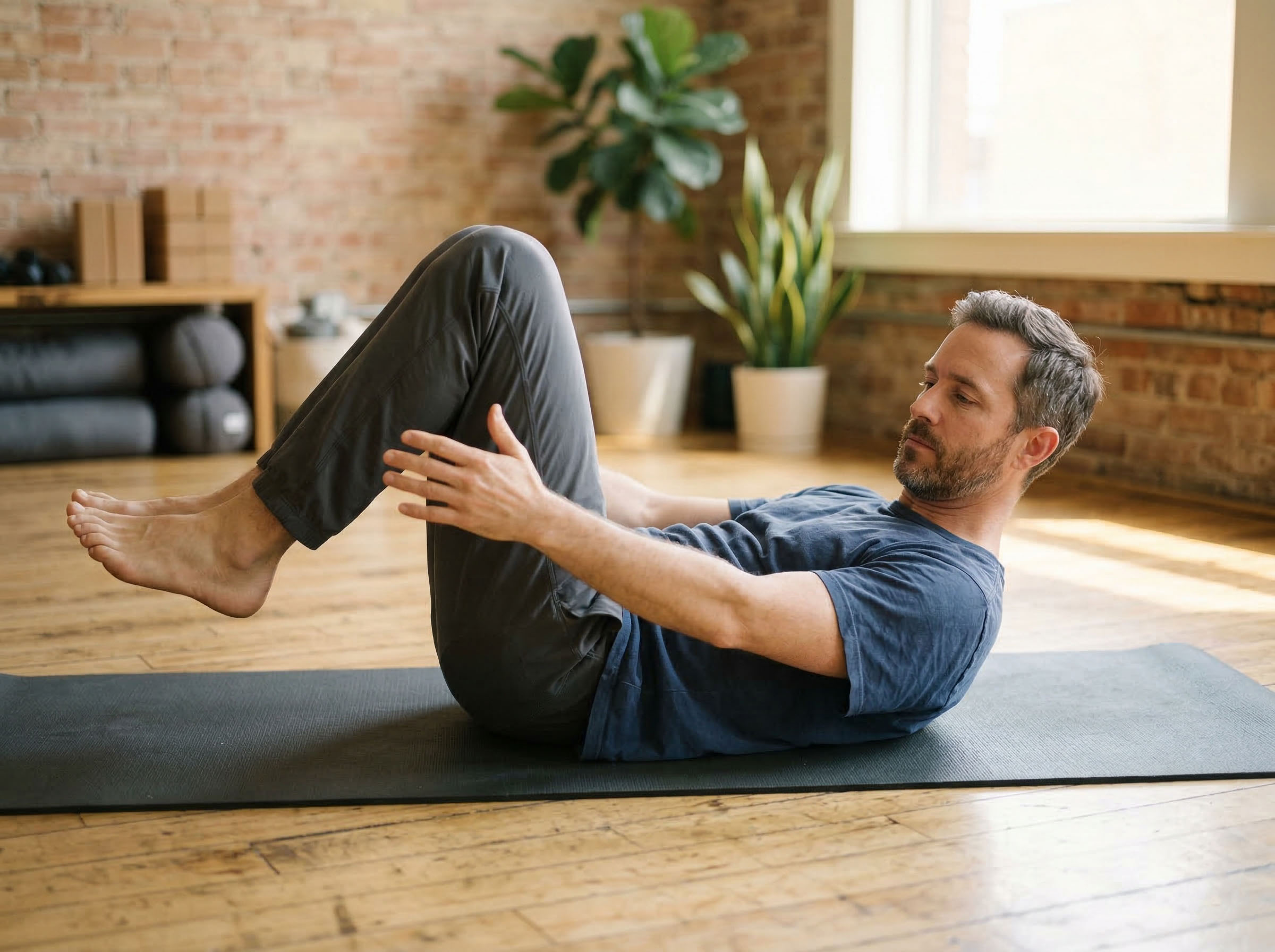
After 40, the physiological changes that start compounding — reduced testosterone, reduced neural density, reduced connective tissue elasticity — affect the pelvic floor along with everything else. The difference is that most other age-related muscular declines get addressed through resistance training, diet, and lifestyle. The pelvic floor usually gets nothing.
The consequences show up gradually. Urinary urgency. The need for a longer warm-up before erection quality reaches its ceiling. A subtle reduction in ejaculatory force. Less intense orgasms. These changes are normal in the sense that they're common, but they're not inevitable. They're at least partially a training deficit playing out over decades.
Research consistently shows that men who maintain pelvic floor conditioning through middle age retain significantly better urinary control and erectile function than those who don't. The baseline you build at 30 matters a great deal by 55. That's not fearmongering. That's just physiology with a long timeline.
Worth Knowing
Prostate surgery — which affects tens of thousands of men annually — almost always results in temporary pelvic floor dysfunction. Men who trained these muscles before surgery consistently recover bladder control and sexual function significantly faster than those who hadn't. If you're over 45, this is a reason to start training now rather than in response to an event.
Making It Part of Your Training
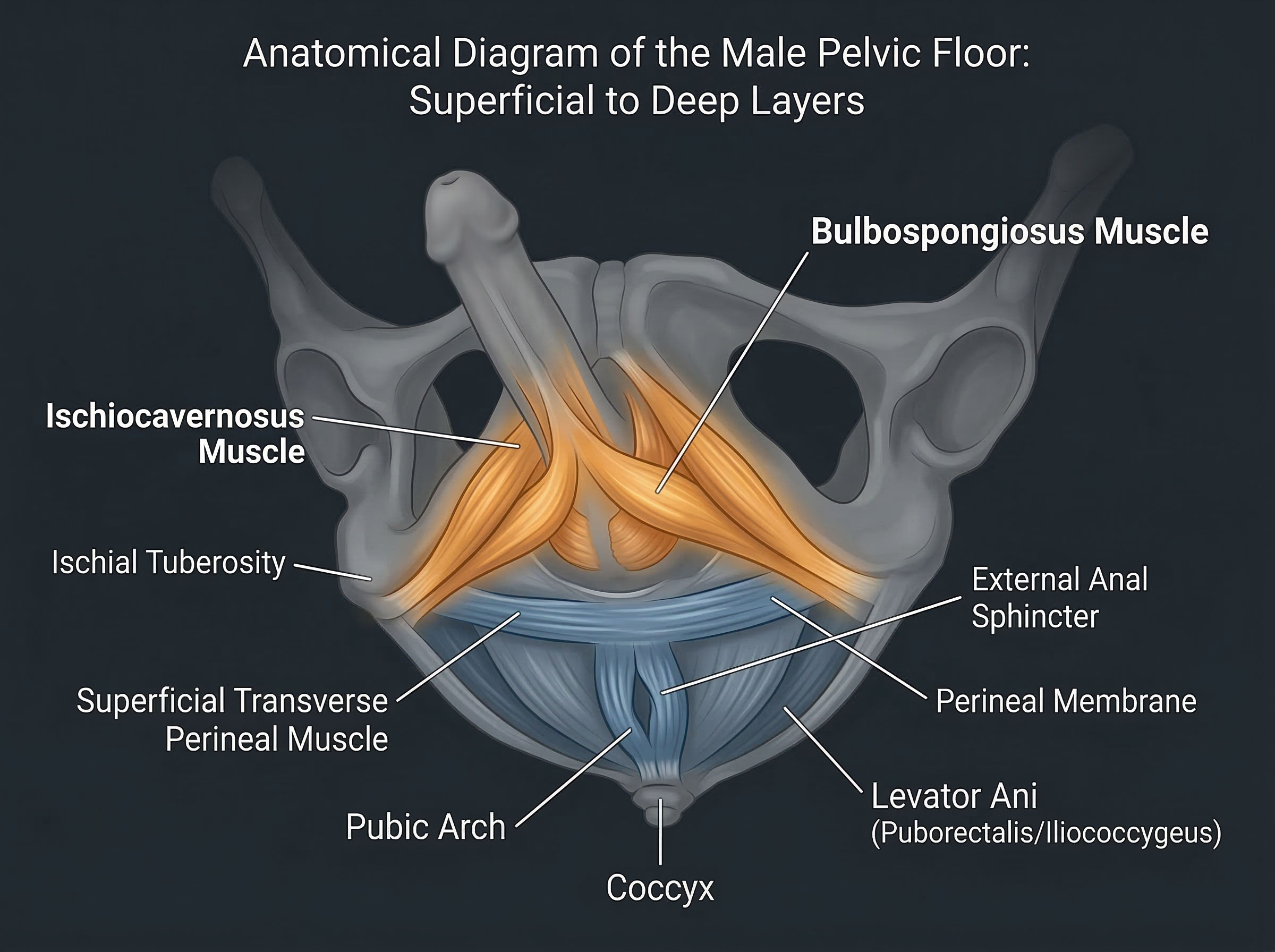
You don't need a separate workout. Pelvic floor work integrates cleanly into what most men already do. The key is intentional bracing during compound movements — specifically, contracting the pelvic floor as part of your core brace before the eccentric phase of a squat or deadlift, and maintaining that tension through the concentric. Most men brace with their abs and forget everything underneath.
Standalone work takes minutes. Three sets of slow holds in the morning. Three sets of fast-twitch contractions during your warmup. That's your floor covered. The adaptation timeline is short — most men notice real changes within a month. Consistent training for three months produces functional differences that are noticeable in everyday life and directly apparent during sex.
For men dealing with specific symptoms — inconsistent erection quality, reduced sensation, or control issues — a session or two with a men's pelvic health physiotherapist is worth considering. These specialists perform functional assessments that tell you whether your floor is weak, tight, uncoordinated, or some combination. Self-directed training without that information is still useful, but professional assessment is more precise.
Q & A
Common Questions About Pelvic Floor Training for Men
The Muscle Group That Earns Its Reputation
Men spend time training muscles they can see. Back, chest, arms, legs. The results are visible, the effort is tangible, the culture supports it. The pelvic floor offers none of that external validation. You can't flex it in the mirror. Nobody at the gym is going to notice. The improvements show up where they matter most — in performance that's private, in function that compounds over time, in a quality of physical life that doesn't degrade on schedule.
That's a different kind of discipline. It requires training a muscle because it performs, not because it looks good. Which, if you think about it, is what serious training has always been about.
The men who train this regularly — the athletes, the coaches, the surgeons who deal with what happens when it's ignored — they don't treat it as a footnote. They treat it as foundational. The pelvic floor holds your body up. It holds your continence. It drives your sexual function. It stabilizes every heavy thing you lift. Calling it underrated isn't hyperbole. It's an accurate description of how consistently men ignore something that directly controls their quality of life.
Start training it. The return on investment is absurdly high.
"The men who build this foundation early don't just perform better. They age differently — with control, with function, with the kind of physical confidence that doesn't depend on everything still working by accident."
— Adrian Lowe
Disclaimer: The articles and information provided by Genital Size are for informational and educational purposes only. This content is not intended to be a substitute for professional medical advice, diagnosis, or treatment. Always seek the advice of your physician or another qualified health provider with any questions you may have regarding a medical condition.