


 日本語
日本語  Deutsch
  English
  Español
  Français
  Português
Long before gyms, status symbols, or social media flexing, men were already measuring themselves against one another — sometimes literally. Across cultures and centuries, the penis became a stand-in for something far larger: authority, virility, courage, and the right to lead. That association didn't happen by accident. It was built, brick by brick, into the foundations of civilization itself.
So where did it come from? Why did so many unconnected societies — from ancient Greece to feudal Japan, from Mesoamerica to sub-Saharan Africa — arrive at roughly the same symbolic equation? And more importantly, what does it actually mean for men today who are still quietly navigating the same anxieties their ancestors carved into stone?
This isn't a self-help piece. It's a reckoning with history. Pull up a seat.
The Ancient World Wasn't Subtle About It
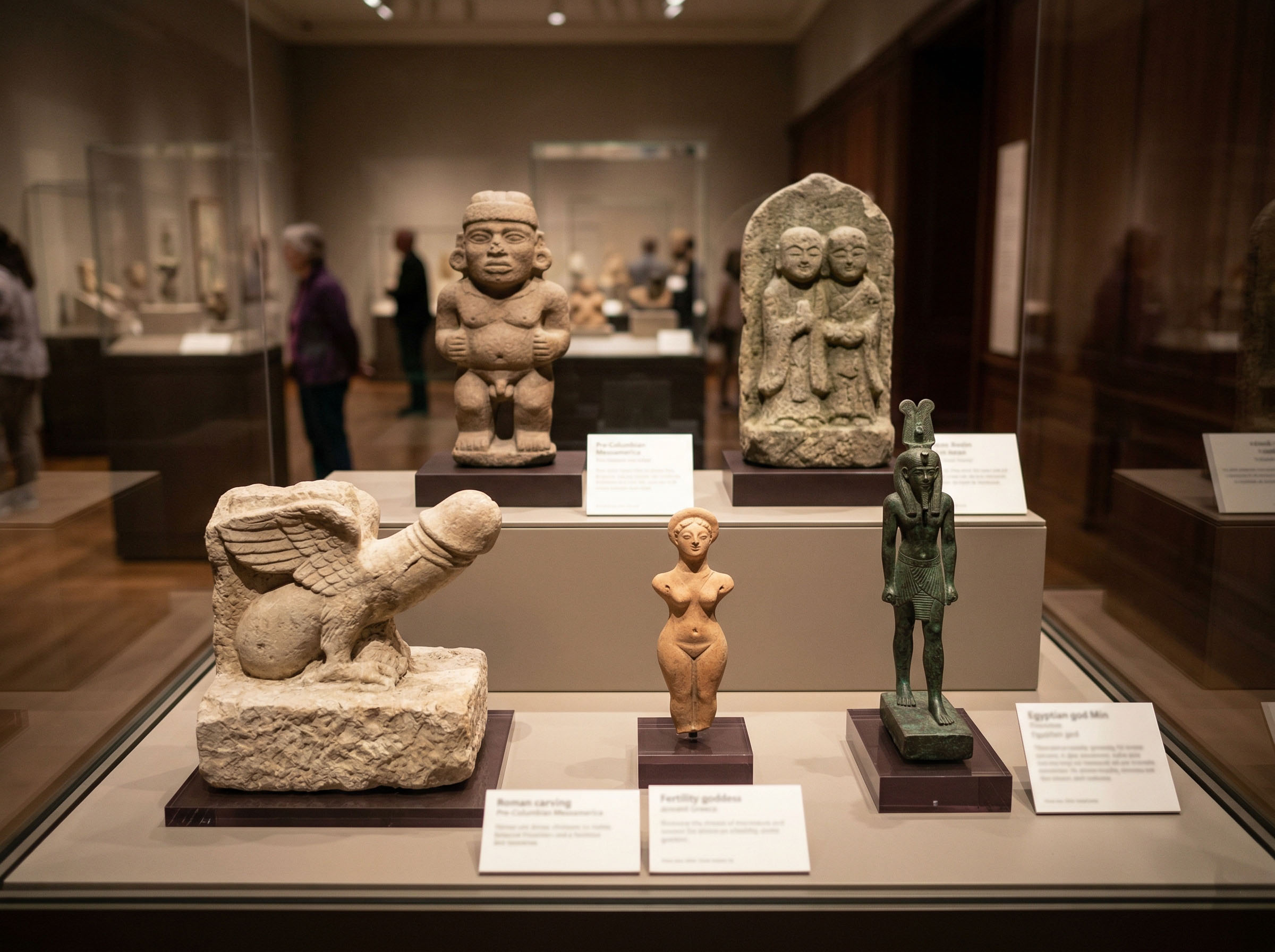
Walk through any major museum with a collection of Greco-Roman antiquities and you'll notice something: the gods of power and war are almost universally depicted with modest — sometimes laughably small — genitalia. In classical Greek sculpture, the ideal male form featured a small, neat penis. Large genitals were associated with satyrs, barbarians, and men of low social standing. Size, in that context, was actually coded as base.
But flip the lens just a few hundred miles east or south, and the story changes completely. In ancient Egypt, the fertility god Min was depicted with a permanently erect, generously proportioned phallus — and he was among the most important deities in the pantheon. In India, the lingam — a stylized representation of Shiva's generative force — became one of the most widely worshipped symbols in history, representing not just sexuality but cosmic creative power.
Even the Greeks weren't consistent. Priapus, the god of gardens and fertility, was depicted with an enormous, permanent erection — a grotesque figure meant to ward off thieves and bring abundance to crops. His exaggerated size wasn't aspirational; it was magical, almost monstrous. Power made visible.
The contradiction here is revealing. Across cultures, the penis became a symbolic container for competing anxieties: fertility versus restraint, virility versus civilization, animal nature versus social order. Which meaning a society poured into the symbol depended on what that society feared or desired most.
War, Conquest, and the Body as Trophy
If fertility explains part of the equation, war explains the rest. Across dozens of ancient cultures, military victory was literalized through the body — specifically, through genital mutilation of the defeated. Egyptian pharaohs recorded their battlefield conquests not just in captive counts, but in piles of severed hands and penises collected from fallen enemies. Merneptah's victory stele from around 1208 BCE lists over 13,000 enemy phalli taken as trophies after a single campaign. This wasn't sadism for its own sake. It was accounting — a body count made permanent and unmistakable.
The logic was visceral and direct: to take a man's phallus was to strip him of his claim to manhood, to fatherhood, to lineage, to the future. In cultures where a man's worth was measured by his capacity to reproduce and protect his bloodline, nothing communicated total defeat more completely. Power didn't just defeat the enemy — it unmade him.
This association between the phallus and conquest filtered upward into the iconography of leadership. Kings and gods were depicted with exaggerated sexual potency because sexual potency and political potency were understood as the same force wearing different clothes. The pharaoh who could father hundreds of children and the pharaoh who could conquer neighboring nations were both demonstrating the same fundamental attribute: dominance over life itself.
"To take a man's phallus was to strip him of his claim to manhood, to fatherhood, to lineage, to the future. Power didn't just defeat the enemy — it unmade him."
— Theo Navarro, Cultural & Identity
The Psychology Hiding Behind the Myth
History gives us the context. Psychology gives us the engine. Why did these beliefs stick? Why do they still stick, in modified form, even now?
Evolutionary psychologists have long noted that male competition — for status, resources, and mates — is one of the most consistent behavioral patterns across human societies. Men are wired, at a basic level, to assess their position in a hierarchy and to care deeply about that position. In ancestral environments, hierarchy wasn't an abstraction. It determined access to food, safety, and reproductive partners. Losing status could literally mean death or genetic dead-end.
The body became the most immediate available scoreboard. Physical size, strength, and — in the absence of clothing — genital endowment all fed into the rapid, largely unconscious assessments men make about one another. In communal bathing cultures, military barracks, and agricultural societies where clothing was minimal, these comparisons were inescapable.
Here's the catch most people miss: the belief that "bigger equals more powerful" was never really about sex. It was about status anxiety wearing a sexual costume. Men who felt powerful weren't necessarily the most well-endowed — but in the storytelling that cultures built around power, the two became inseparable. The myth reinforced the hierarchy, and the hierarchy reinforced the myth.
Did You Know?
A 2015 study published in the Proceedings of the National Academy of Sciences found that flaccid penis length was one of several physical traits — including height and shoulder-to-hip ratio — that influenced women's ratings of male attractiveness in a non-sexual context. Crucially, the effect diminished significantly once height and body proportion were accounted for. The researchers concluded that size was a minor factor compared to overall physical presence — meaning the cultural obsession is massively disproportionate to any actual reproductive advantage.
What Women Actually Think (Versus What Men Fear They Think)
This is where the mythology and reality part ways most dramatically.
Survey after survey, across multiple decades and countries, consistently shows that women rank penis size well below other factors when evaluating sexual partners and relationship satisfaction. Emotional connection, communication, confidence, ability to provide, technique, and physical fitness all rank higher — often by significant margins. When women are surveyed specifically about size preferences, the majority indicate that average is not just acceptable but preferred, citing comfort as the primary concern.
The consistent outlier is men's perception of what women want — which tends to be dramatically inflated. Men systematically overestimate how much their partners care about size. This gap between male anxiety and female reality is one of the most reliably replicated findings in sex research.
So why does the myth persist? Because it was never designed to impress women. The preoccupation with size is primarily a male-to-male phenomenon — a holdover from the hierarchy-sorting logic described above. The audience for the anxiety was always other men, not women. Women got pulled into the story as the supposed judges of a competition they largely weren't watching.
Table: What the Phallus Symbolized Across Civilizations
| Civilization | Primary Symbolism | Associated With | Cultural Context |
|---|---|---|---|
| Ancient Greece | Fertility & Comedy / Satire | Dionysus, Priapus | Small genitals = refinement; large = base or divine excess |
| Ancient Rome | Protection & Luck | Fascinus (divine phallus) | Amulets worn by soldiers, children; baked into bread |
| Ancient Egypt | Fertility & Conquest | Min, Pharaonic power | Enemy phalli taken as battle trophies; fertility rites |
| Hindu (India) | Cosmic Creative Force | Shiva Lingam | One of most widely worshipped symbols in world religion |
| Japan (Shinto) | Agricultural Abundance | Kanamara Matsuri festival | Annual fertility festival; phallic shrines still active today |
| Mesoamerica (Aztec) | Life Force & Solar Power | Xipe Totec, renewal rituals | Genital offerings tied to agricultural cycles and rebirth |
| Sub-Saharan Africa | Lineage & Ancestral Strength | Initiation rites, ancestor totems | Virility tied to community survival and elder status |
The Colonial Filter: How Size Became a Racial Weapon
No honest examination of this topic can skip what happened during the age of European colonialism — because it's where the myth got its darkest chapter and most toxic modern legacy.
European colonizers, seeking to justify the subjugation of African men, deliberately constructed a narrative around black male sexuality that was equal parts fear and contempt. The "well-endowed black man" trope was not a compliment — it was a dehumanization tool. By framing African men as sexually excessive, European colonizers positioned them as animalistic, threatening, and inferior in the ways that "civilized" men (according to Greek-derived ideals of moderation) prized most.
This is the same contradictory logic as ancient Greece: the small, restrained phallus meant refinement and control; the large one meant power unchecked, dangerous, raw. Colonial propaganda weaponized both ends of that spectrum simultaneously, using sexual anxieties to justify brutality and racial hierarchy.
The residue of that propaganda is still with us. The racial stereotypes around penis size that circulate in modern culture — jokes, pornography, social media posts — are not harmless curiosities. They are artifacts of a very specific historical project designed to sort men into hierarchies of humanity. Men of all backgrounds who have absorbed these stereotypes — whether as flattering or damaging — are carrying someone else's 400-year-old agenda.
Worth Calling Out
The myth of size and power was always a political tool — not a biological fact.
Every culture that linked penis size to authority or status did so to serve a specific social agenda — whether that was reinforcing a warrior class, justifying conquest, or building a racial hierarchy. The belief was constructed. It can be deconstructed.
Modern Men, Ancient Anxiety
Somewhere between ancient Egypt and the smartphone, the mythology changed channels without changing its message. Now it runs on locker-room talk, pornography industry standards, and the quiet dread that settles in when a man compares himself — even accidentally — to an unrealistic benchmark.
The pornography industry deserves a specific mention here. It is not, by any stretch, a representative sample of human anatomy. Performers are selected partly for physical attributes that fall well outside statistical norms. Watching pornography as a gauge of what's "normal" is roughly equivalent to watching NBA games to gauge how tall the average man is. The comparison will always make you feel short.
Research consistently shows that the majority of men who seek medical consultation for concerns about penis size — a condition sometimes called penile dysmorphic disorder — fall within the normal range of measurements. The issue is not anatomy. The issue is perception, shaped by decades of cultural messaging that most men have never been given tools to critically examine.
The average erect penis length, based on large-scale studies using researcher measurements, is typically between 5.1 and 5.5 inches (13–14 cm). This figure has remained relatively consistent in many high-quality analyses, though data on variations by ethnicity and geography are limited and incomplete. Additional factors, such as differences in measurement methods, the age and health of participants, and potential temporal trends, also affect reported results. As with any human physical trait, significant natural variation exists. However, the true range of what is considered 'normal' is both wider and more moderate than popular myths suggest.

The Real Drivers: What Actually Makes Men Feel Powerful
Strip away the mythology and ask a simpler question: what actually makes men feel confident, capable, and attractive in their own skin?
The answers, when men are asked honestly and anonymously, are fairly consistent. Physical fitness and strength. The ability to provide and protect. Competence in a craft or profession. Being respected by other men. Having a partner who genuinely desires them. Having children they've raised well. Building something that lasts.
Notice what's not on that list. The attributes men describe as sources of deep, durable confidence are almost entirely about action and character — not anatomy. The men who carry themselves with the most grounded confidence are rarely thinking about their measurements. They're thinking about the next thing they're building.
This isn't motivational-poster philosophy. It's pattern recognition. The anxiety around genital size tends to be most pronounced in men who feel powerless in other areas — men who haven't yet built a life that gives them a reliable source of self-respect. The preoccupation is a symptom, not the disease. The disease is a deficiency of genuine masculine confidence, and the cure is never a different measurement. It's a different life.
By the Numbers
85%
of women are satisfied with their partner's size (Archives of Sexual Behavior)
45%
of men report wishing they were larger — the majority are anatomically average
5.16"
average erect length per BJU International meta-analysis of 15,000+ men
2,400+
years the phallic symbol has been used in organized religion and state power
Circumcision, Culture, and the Politics of the Modified Body
While we're dismantling myths, it's worth acknowledging another arena where cultural belief systems have shaped men's bodies and identities: circumcision. The practice, performed across Jewish, Muslim, and numerous African traditions as well as in mainstream American medical culture throughout the 20th century, has been draped in claims about cleanliness, health, and even sexual performance that have shifted dramatically with each generation of research.
The honest answer from current medical evidence is nuanced: circumcision carries some demonstrated health benefits (reduced UTI risk in infancy, modest reduction in certain STI transmission rates) and some argued costs (altered sensitivity, ethical questions about consent). Neither the pro-circumcision nor the anti-circumcision camp has a clean sweep of the data.
What's clear is that generations of men have had their bodies modified based on cultural beliefs about cleanliness, status, and masculine identity — and most of them were never given a straightforward account of why. That's worth naming honestly.
Reclaiming the Narrative
The societies that linked penis size with power were doing what every society does: taking something they couldn't fully explain — status, dominance, fertility, fear of death — and giving it a body. The phallus was a convenient symbol because it was visible, variable, and already loaded with biological meaning. The power wasn't in the anatomy. The power was always in the story being told about the anatomy.
That story served specific purposes in specific historical moments. It helped organize hierarchies, motivate soldiers, justify conquest, and give men a portable, personal way to locate themselves in a pecking order. In a world without IQ tests, bank accounts, or LinkedIn profiles, the body was the resume.
That world is gone. The resume has been replaced. But the anxiety — that deep, chest-tightening worry that you might be measured and found wanting — is still running on ancient software. It's running on a program written by pharaohs and Roman generals and colonial administrators, not by the actual circumstances of your actual life.
The most powerful thing a man can do with this knowledge isn't to dismiss it or feel ashamed of it. It's to look at it clearly and decide: is this story mine? Or is it someone else's, handed down so many times that it feels like skin?
Real power — the kind that shows up in a man's face when he's built something, raised someone, or stood for something when it would've been easier not to — has never required a measurement. It required a decision.
Make yours.
Common Questions
Frequently Asked: Size, Power & What History Got Wrong
In Brief
- Penis size became linked to power because societies projected their anxieties about status, fertility, and conquest onto the most visible male anatomical difference.
- The specific meaning varied dramatically by culture — the same symbol meant refinement in Greece and divine abundance in India.
- The preoccupation with size is primarily a male-to-male hierarchy concern, not an accurate reflection of what women prioritize in partners.
- Colonial-era racial stereotypes around size were deliberate political tools of dehumanization, not anatomical observations.
- Men who carry the most grounded confidence tend to build it through action, character, and contribution — not anatomy.
- The anxiety is real. The premise it rests on is not. Understanding the difference is the first move.
Disclaimer: The articles and information provided by Genital Size are for informational and educational purposes only. This content is not intended to be a substitute for professional medical advice, diagnosis, or treatment. Always seek the advice of your physician or another qualified health provider with any questions you may have regarding a medical condition.


