


 日本語
日本語  Deutsch
  English
  Español
  Français
  Português
Most men go through their entire lives without thinking about the structural engineering that makes their bodies function. We focus on muscle mass, cardiovascular output, or the visible markers of health, but the foundation of male biology often remains a mystery. When it comes to the penis, the conversation usually stops at performance or size.
However, there is a specific piece of biological hardware—a literal structural cable—that dictates how a man carries himself, how he functions, and how his anatomy interacts with the world.
That hardware is the suspensory ligament.
To understand the suspensory ligament is to understand the difference between a loose appendage and a functional tool. It is the anatomical anchor, the stabilizer that holds the root of the penis to the pelvic bone. Without it, the mechanics of being a man would look and feel fundamentally different.
The Blueprint of the Root
Before we get into what this ligament does, we have to look at where it sits. The penis isn't just an external organ; it’s an iceberg. A significant portion of its length is internal, buried within the pelvis. This internal section is known as the root, consisting of two "crura" (the legs of the organ) that attach to the pubic arch.
The suspensory ligament is the primary connection point between the external shaft and the pubic symphysis—the midline joint where your left and right pelvic bones meet. Think of it as a heavy-duty industrial strap. It originates from the lower part of the linea alba (the vertical line of connective tissue in your abdomen) and the pubic symphysis, then wraps around the base of the penis like a sling.
Physiologically, it is composed of tough, fibrous connective tissue. It isn’t a muscle; you can’t "flex" it or grow it at the gym. It is a static support structure designed to handle tension and maintain the structural integrity of the male frame.
Infographic: The Anchor System
Understanding the internal engineering of male support.
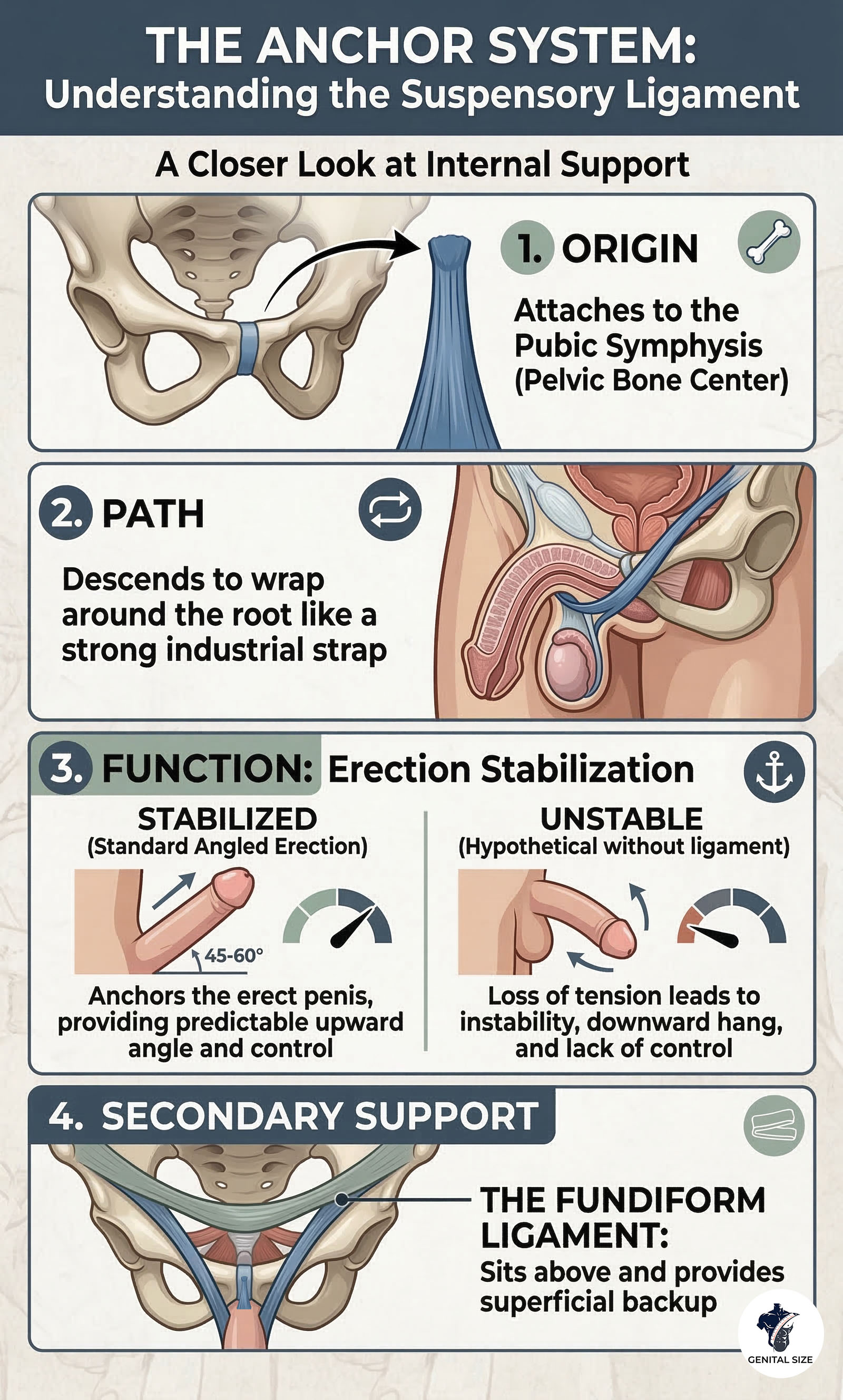
1. Origin: Attaches to the Pubic Symphysis (the center of the pelvic bone).
2. Path: Descends to wrap around the root like a high-strength industrial strap.
3. Function: Provides mechanical stabilization and maintains the erection angle.
4. Secondary Support: The Fundiform Ligament acts as a superficial backup layer.
The Stabilizer: Function and Purpose
The primary job of the suspensory ligament is stabilization. When a man is flaccid, the ligament keeps the organ centered. But its true purpose becomes clear during an erection.
When blood flow fills the corpora cavernosa (the chambers of the penis), the organ gains mass and rigidity. Left to its own devices, a rigid object attached only at the very back would be unstable. The suspensory ligament acts as a guy-wire on a flagpole. It pulls the base of the erect penis upward and toward the belly, creating the "angle of dangling" that most men recognize.
This upward angle isn't just for aesthetics. From an evolutionary and biological standpoint, this positioning is functional. It provides the necessary leverage and stability for physical intimacy, ensuring the organ can withstand pressure and maintain its position without collapsing or shifting excessively. It turns a flexible organ into a stable, directional one.
The Myth of Length and the Surgery Trap
Because the suspensory ligament holds the base of the penis close to the pubic bone, it effectively "hides" a portion of the shaft inside the body. This has led to one of the most controversial topics in men’s health: the suspensory ligament release surgery (ligamentolysis).
The logic used by some practitioners is that if you cut the anchor, the ship moves further out. By severing the ligament, the internal portion of the penis can slide forward, often resulting in an apparent gain of one to two inches in flaccid length.
"The suspensory ligament is the anatomical embodiment of stability. Cutting it for a cosmetic boost is like cutting the suspension cables on a bridge because you want it to look longer."
But here is the hard truth that men need to hear: you don't actually get a larger penis. You just change the geometry.
When you cut the suspensory ligament, you lose the anchor. The result is often an erection that points downward or sways side-to-side because the stabilizer is gone. Men who undergo this procedure frequently report a loss of stability during sex, making the experience more difficult and less predictable. Furthermore, the "gains" are often temporary, as the body’s natural healing process can create scar tissue that pulls the organ back in, sometimes even further than before.
In the world of biology, there is rarely a free lunch. The suspensory ligament is there for a reason. Cutting it for a cosmetic boost is like cutting the suspension cables on a bridge because you want the bridge to look longer; you might get the look, but you’ve compromised the structural integrity.
| Feature | Marketing Claim | Biological Reality |
|---|---|---|
| Length | Significant permanent growth. | Apparent gain only; no new tissue created. |
| Stability | No change in function. | Loss of upward angle and directional control. |
| Recovery | Quick and seamless. | Risk of scar tissue retracting the organ. |
Biological Variation: The Normal Range
Every man’s suspensory ligament is slightly different. This accounts for the vast range of "normal" when it comes to the angle of an erection.
Some men have a very tight, short suspensory ligament. This results in an erection that points sharply upward, sometimes almost touching the abdominal wall. Other men have a longer or more flexible ligament, leading to an erection that points straight out or even slightly downward.
Neither of these is "better" than the other. They are simply variations in the tension of the connective tissue. Factors that influence this include:
- Genetics: Your blueprint is set at birth.
- Age: Like all connective tissue, the ligament can lose some elasticity over decades.
- Pelvic Tilt: The way you stand and the orientation of your pelvis can change the tension on the ligament.
Did You Know?
The suspensory ligament is so strong that it can support several times the weight of the organ itself. This high level of tensile strength is necessary because, during physical activity, the ligament acts as a shock absorber, protecting the delicate internal blood vessels and nerves from sudden impact or displacement.
The Fundiform Ligament: The Secondary Support
While the suspensory ligament gets all the attention, it has a partner: the fundiform ligament. This is a more superficial structure that sits just in front of the suspensory ligament. It originates from the fascia of the abdominal muscles and splits into two bands that circle the penis before uniting underneath it.
If the suspensory ligament is the main anchor, the fundiform ligament is the secondary safety strap. It helps support the weight of the organ and contributes to the overall symmetry of the male anatomy. These two structures work in tandem to ensure that everything stays where it belongs, even during high-impact physical activity.
The Pelvic Integrity Checklist
- ✅ DO: Maintain a healthy body fat percentage to reveal natural anatomy.
- ✅ DO: Practice pelvic floor engagement to support connective tissue.
- ❌ DON'T: Engage in high-force mechanical "stretching" devices.
- ❌ DON'T: Sever structural ligaments for purely cosmetic reasons.
Protection and Maintenance
While you can't "train" your ligaments like you train your biceps, you can protect them. Ligamentous injuries in the pelvic region are rare but serious. A "penile fracture," which is actually a rupture of the tunica albuginea (the casing of the erectile tissue), often involves extreme stress on the suspensory ligament as well.
The best way to maintain the health of these structures is to maintain overall pelvic health:
- Maintain a Healthy Weight: Excess abdominal fat (the "pad" of fat over the pubic bone) can bury the external portion of the shaft, making the suspensory ligament work harder to support the weight and effectively shortening the visible anatomy.
- Pelvic Floor Strength: While the ligament is passive tissue, the muscles around it—the ischiocavernosus and bulbospongiosus—are active. Strengthening these muscles through Kegel exercises supports the entire pelvic floor, taking some of the mechanical load off the connective tissues.
- Avoid Extreme Mechanical Stress: Sudden, forceful bending of the erect penis can strain or tear the suspensory ligament. Being aware of body mechanics during physical intimacy is the best form of prevention.
The Psychology of the Anchor
There is a psychological component to understanding this anatomy. Many men feel a sense of inadequacy based on how they compare to stylized, unrealistic images. Understanding that your "angle" or "hang" is dictated by a specific ligament—a piece of structural cordage—can help strip away the shame.
It is a reminder that the male body is a machine built for function. The suspensory ligament isn't about aesthetics; it’s about the ability to perform a biological role. When you view your body through the lens of engineering and physiology, you stop worrying about "normal" and start focusing on "functional."
Frequently Asked Questions
The Bottom Line on the Anchor
The suspensory ligament is a silent partner in male health. It doesn't produce hormones, it doesn't pump blood, and it doesn't send signals to the brain. But it provides the literal framework for a man's most intimate functions.
By understanding this structure, men can make better decisions about their health, avoid dangerous cosmetic "shortcuts," and gain a deeper appreciation for the complex biological engineering that makes them men. You are built for a purpose, and your anatomy—right down to the ligaments—is proof of that design.
Disclaimer: The articles and information provided by Genital Size are for informational and educational purposes only. This content is not intended to be a substitute for professional medical advice, diagnosis, or treatment. Always seek the advice of your physician or another qualified health provider with any questions you may have regarding a medical condition.


