


 日本語
日本語  Deutsch
  English
  Español
  Français
  Português
In the world of high-stakes performance, whether it’s a fourth-quarter drive on the gridiron, a critical boardroom negotiation, or protecting your family in a moment of crisis, a man is defined by his ability to remain composed under pressure.
We prize the "clutch" gene—the ability to shut out the noise, find the flow state, and execute.
Yet, there is one arena where even the most disciplined men often find their composure shattered by an invisible enemy. It isn't a physical ailment or a lack of desire. It is a psychological loop that can turn a confident provider into a spectator of his own failure. We are talking about performance anxiety—the "spectator effect" that has sidelined more men than any physical injury ever could.
To understand how to master this, we have to look past the quick-fix pills and the marketing fluff. We need to look at the hard-wiring of the male brain, the biological reality of the stress response, and the tactical shifts required to regain command of the bedroom.
Quick-Start: Performance Mindset
Do: Focus on physical sensation, not mental critique.
Don't: View a single "off" night as a failure of your masculinity.
The Biology of the Fight-or-Flight Stall
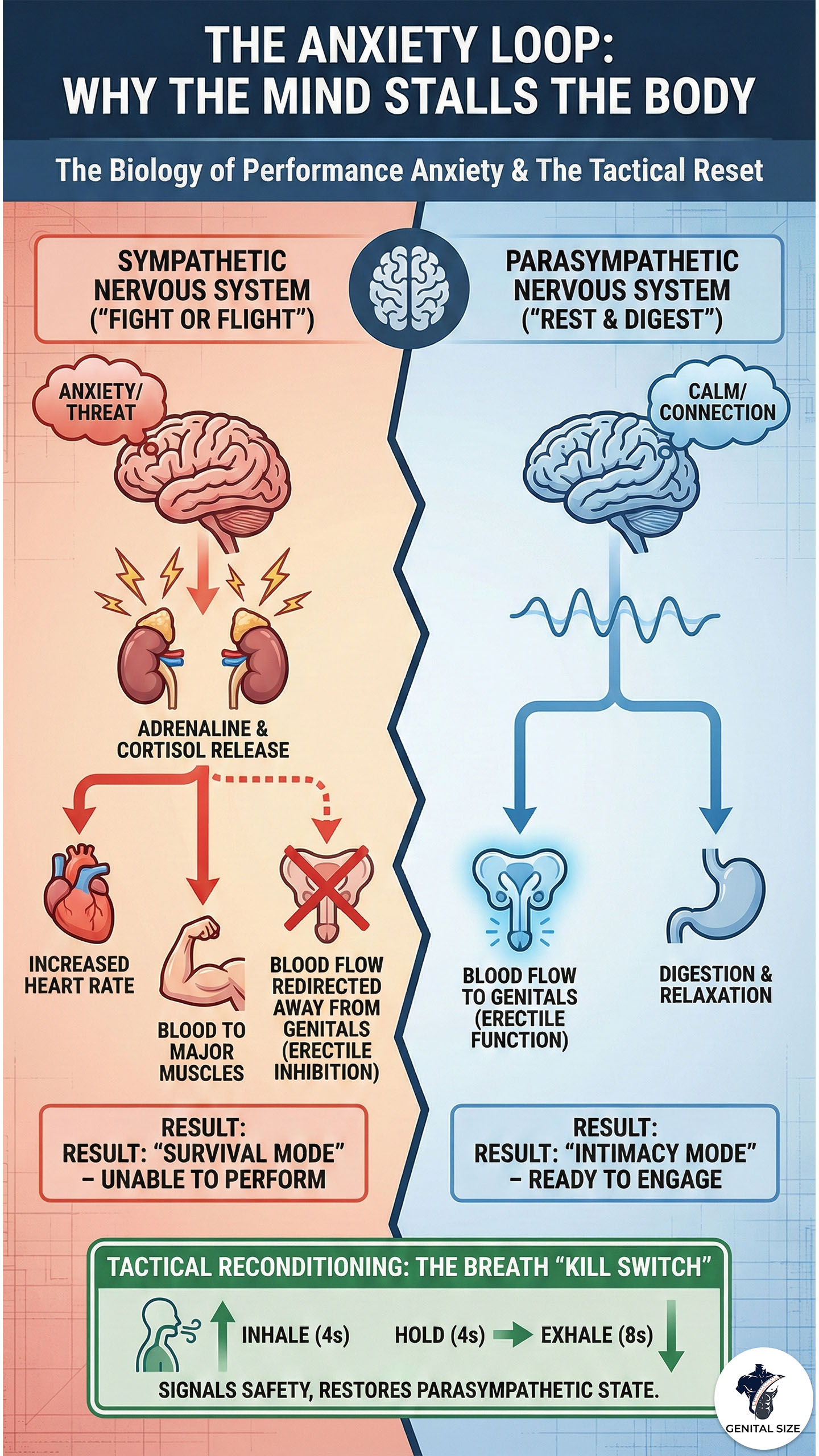
Before we address the mind, we must acknowledge the machinery. A man’s body is a hydraulic system governed by the nervous system. Specifically, sexual function is a delicate balance between the parasympathetic nervous system (the "rest and digest" state) and the sympathetic nervous system (the "fight or flight" state).
For a man to perform, he must be in a state of relative physiological calm. However, when anxiety enters the room, the brain perceives a threat. It doesn’t matter if the threat is a saber-toothed tiger or the fear of "not being enough" for his woman; the chemical response is identical. The brain dumps adrenaline and cortisol into the bloodstream.
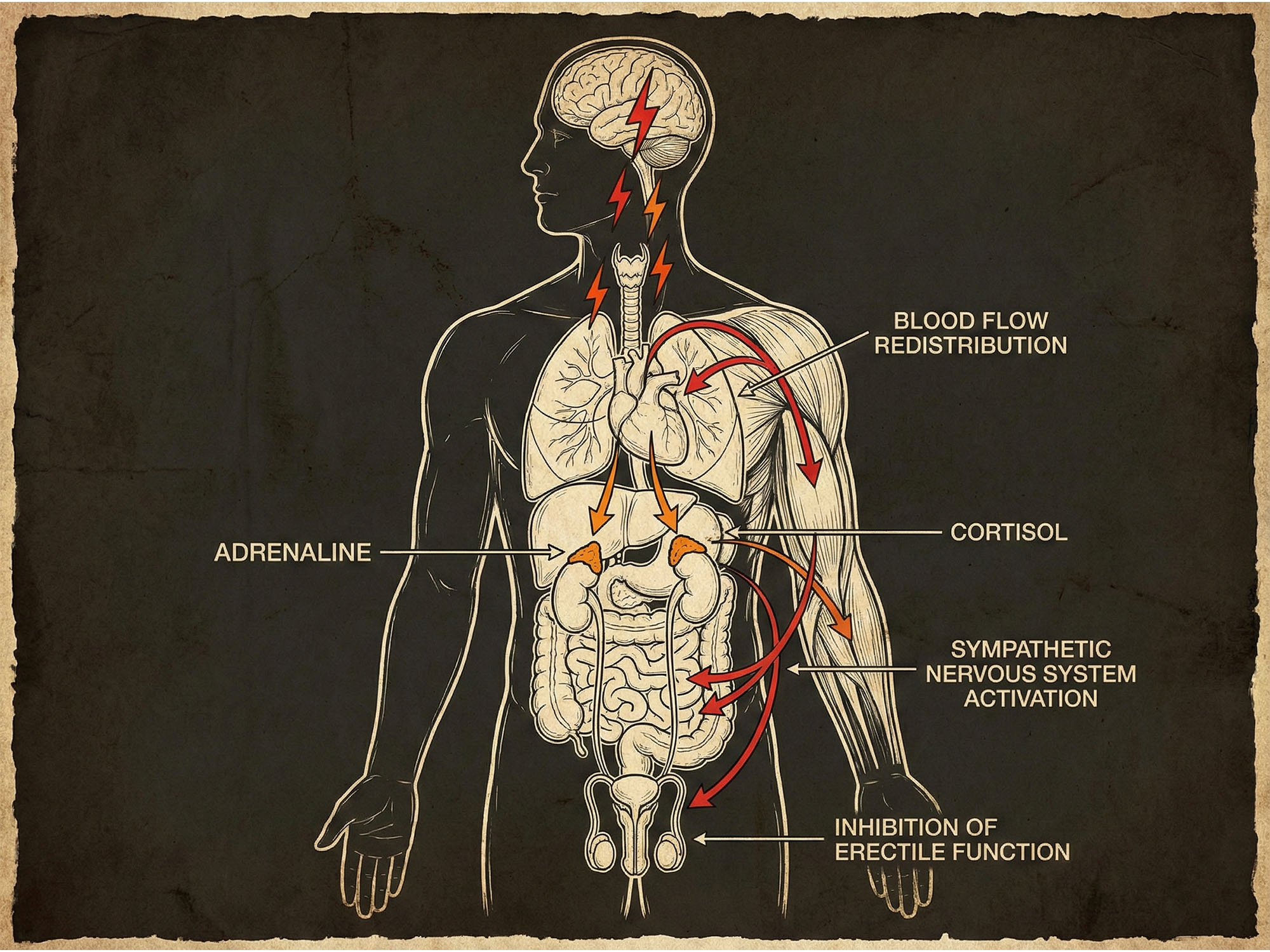
Adrenaline is designed to pull blood away from the extremities and the reproductive organs, channeling it instead to the heart, lungs, and major muscle groups so you can fight or run. In short: You cannot be in "survival mode" and "performance mode" at the same time. When you are anxious about your performance, your body biologically prepares you to leave the situation, not to deepen your connection within it.
The Spectator Effect: The Man in the Mirror
The psychological hallmark of this anxiety is what researchers call "spectatoring." Instead of being an active participant in the intimacy with his wife or partner, the man begins to view himself from the outside. He becomes a critic, watching his own "performance" and judging it in real-time.
-
"Is it staying firm?"
-
"Is she enjoying this, or is she just being polite?"
-
"What happens if I lose it right now?"
The moment a man starts asking these questions, he has exited the experience. He is no longer feeling the physical sensations; he is analyzing them. This analytical shift kills arousal because the brain’s "logic center" (the prefrontal cortex) has overridden the "pleasure center."
The Provider’s Burden: The Source of the Pressure
The Stoic Perspective
The ancient Stoics understood that we suffer more in imagination than in reality. For the traditional man, "performance" was never about perfection, but about the virtue of presence. Marcus Aurelius famously noted that we should be like the rocky headland on which the waves break; it stands fast of itself and the froth of the water sinks to rest around it.
Historical men viewed intimacy as a sanctuary from the world's battles, not a secondary battlefield.
Why do modern men face this more than previous generations? While the biology hasn't changed, the cultural expectations have. We live in an era of hyper-performativity. From social media to the unrealistic depictions of intimacy in modern media, men are often led to believe they must be "on" at all times, possessing an almost mechanical reliability.
Traditional masculinity is rooted in being a provider and a protector. We take pride in our utility—our ability to get the job done. While this drive is what makes men successful in their careers and as heads of households, it can be a double-edged sword in the bedroom. If a man ties his entire sense of worth to his "utility" in an intimate setting, any perceived failure becomes a direct hit to his identity.
When a man feels he is failing to provide pleasure or "perform his duty," the shame spiral begins. Shame is the ultimate performance killer. It creates a feedback loop: one "off" night leads to anxiety about the next night, which ensures the next night will also be "off."
Tactical Reconditioning: Breaking the Loop
To fix the engine, you don't just keep turning the key; you have to clear the flooded cylinders. Overcoming performance anxiety requires a tactical approach to both the mind and the environment.
1. Reclaiming the Lead
In most areas of life, men are expected to lead. In an intimate setting, leading doesn't mean "dominating" in a crass sense; it means taking responsibility for the atmosphere. If you are anxious, the atmosphere becomes tense.
The first step is to remove the "goal-oriented" mindset. In business, goals are everything. In intimacy, being overly goal-oriented (focusing only on the final act) creates a "pass/fail" scenario. By shifting the focus to the journey—the physical connection, the touch, the presence—you lower the stakes. If there is no "finish line" to cross, there is no way to "fail."
2. The Power of Physiological Regulation
Since anxiety is a physical state, you can use physical tools to counter it. Controlled, diaphragmatic breathing—the kind used by elite marksmen and special operators—signals to the brain that there is no immediate threat.
The Tactical Breath: Inhale for four seconds, hold for four, exhale for eight. The long exhale is the "kill switch" for the sympathetic nervous system. It forces the body back into a parasympathetic state, allowing blood flow to return where it belongs.
3. Communication Without Weakness
There is a misconception that talking about performance issues makes a man look weak. On the contrary, a man who can address a problem head-on displays a level of confidence that "faking it" never can.
If you find yourself caught in your head, the best way to break the spell is to acknowledge it briefly to your woman. "I’m in my head tonight; I just want to focus on you for a bit." This simple admission offloads the cognitive burden. It stops the "spectatoring" because the secret is out. Usually, you’ll find that a supportive woman is far more interested in your presence and your connection than a "perfect" performance.
"The moment a man starts asking 'How am I doing?', he has stopped doing it and started watching it. You cannot be the actor and the critic at the same time."— Noah Renaud
The Role of Lifestyle and Physical Readiness
While the root of performance anxiety is often mental, a man’s confidence is bolstered by his physical state. A body that is neglected is a mind that is prone to doubt.
| Factor | Impact on Performance Mindset | Action Step |
|---|---|---|
| Sleep | Low sleep spikes cortisol, making anxiety more likely and reducing mental resilience. | Aim for 7-8 hours of hard rest to keep the nervous system steady. |
| Cardio | Poor circulation leads to "equipment failure," which causes immediate mental doubt. | 150 minutes of zone 2 cardio weekly to ensure vascular health. |
| Strength | Lifting weights increases testosterone and reinforces a capable self-image. | Focus on heavy compound movements like squats and deadlifts. |
| Nutrition | High sugar and processed foods lead to inflammation, lethargy, and brain fog. | Prioritize whole foods, lean proteins, zinc, and magnesium. |
A man who knows his "vessel" is in top condition has one less thing to worry about. When you know your heart is strong and your hormones are balanced, the nagging voice of doubt has less evidence to use against you.
Reframing the "Role" of the Man
We must return to a more grounded, traditional understanding of intimacy. It is not a Broadway show where you are the lead actor being judged by an audience of one. It is a shared experience between a man and a woman.
The "Adventurous Provider" doesn't just provide financial security or physical protection; he provides a space of security and passion for his woman. When you view your role as providing a shared experience rather than "hitting a mark," the pressure dissipates.
True sexual confidence comes from competence and connection. Competence is knowing your body and how it works; connection is being tuned in to your partner rather than yourself.
Common Questions
The Path Forward: From Spectator to Participant
If you have struggled with this, know that you are in the company of millions of men. The bravest men in history have dealt with the "white lights" of performance pressure. The difference between those who are overcome by it and those who master it is the willingness to train the mind.
Stop viewing your body as a machine that must perform on command, and start viewing your mind as the captain of the ship. If the captain is panicked, the crew will fail. If the captain is calm, focused, and present, the ship will weather any storm.
Mastering the psychology of performance isn't about finding a "hack." It's about a return to the fundamentals:
-
Presence over Analysis.
-
Connection over Performance.
-
Physiological Control over Panic.
By applying these principles, a man moves from the sidelines of his own life back into the game, with the confidence and the composure that his role demands.
Disclaimer: The articles and information provided by Genital Size are for informational and educational purposes only. This content is not intended to be a substitute for professional medical advice, diagnosis, or treatment. Always seek the advice of your physician or another qualified health provider with any questions you may have regarding a medical condition.