



 日本語
日本語  Deutsch
  English
  Español
  Français
  Português
There was a time when the foreign policy of a nation was built on the bedrock of three cold, hard realities: geography, resources, and the credible threat of force. It was a world where men looked at maps and saw chessboards, where the primary goal was the preservation of the state and the protection of its borders.
But over the last decade, a new experiment has taken root across the Western world. It is called "Feminist Foreign Policy" (FFP).
On paper, it sounds like an advancement—a move toward "equity" and "peacebuilding." In practice, however, many men across the globe are looking at the wreckage of their social contracts and wondering if the price of this experiment has been the safety of their families and the stability of their culture.
To understand where we are, we have to look at where the iron met the silk. When a state decides that its primary lens for international relations is no longer national interest, but rather the promotion of gendered social engineering, the internal foundation begins to crack. We aren’t talking about the noble pursuit of ensuring women can vote or work; we are talking about a fundamental shift in how a nation perceives its duty to its own citizens versus its duty to a globalist ideal.
The Genesis of the Experiment
Sweden was the pioneer. In 2014, then-Foreign Minister Margot Wallström officially launched the world’s first Feminist Foreign Policy. The goal was simple: prioritize the "three Rs"—Rights, Representation, and Resources for women. It was hailed by the international press as a breakthrough in human rights. But foreign policy does not exist in a vacuum. It is the external expression of internal values.
When Sweden exported these values, it simultaneously imported a set of challenges that the FFP framework was fundamentally unequipped to handle. The logic of FFP suggests that "soft power"—dialogue, aid, and social programs—can replace the traditional deterrents of a sovereign nation.
Since Sweden’s pivot, several nations have followed suit, including Canada, France, Germany, and the Netherlands. While each nation has its own flavor of the policy, the core remains the same: a focus on "human security" over national security. But for the men who live in these countries, the shift has felt less like progress and more like a retreat from the reality of a dangerous world.
Sweden: The Warning Shot
If Sweden was the laboratory, the results are now coming back from the lab—and they are grim. For decades, Sweden was the gold standard of Scandinavian stability. It was a high-trust society where doors were left unlocked and children walked to school alone.
Then came the 2015 migrant crisis. Under the banner of a "humanitarian" and "feminist" approach to borders, Sweden accepted more refugees per capita than almost any other European nation. The intent was compassionate, but the execution ignored the fundamental masculine duty of a state: to vet those who enter and to protect the internal peace.
The results have been a statistical nightmare. Sweden now grapples with some of the highest rape statistics in Europe. While official government narratives often attempt to obscure the link between mass immigration and sexual violence, the data from independent researchers and law enforcement paints a different picture. For the women and children of Sweden, the very people the FFP was designed to "protect" globally, the domestic reality has become significantly more dangerous.
Furthermore, the economic strain of maintaining an expansive welfare state while absorbing a large population that is not integrated into the workforce has led to a slow-burning fiscal crisis. When you prioritize the "Rights and Resources" of the world over the "Security and Stability" of your own neighborhoods, the middle-class man—the one paying the taxes and raising the next generation—is the one who feels the squeeze.
Sweden: The Breakdown of Internal Safety
While Germany faces an economic crisis, Sweden is grappling with a crisis of public safety and social cohesion. For a decade, Sweden’s "feminist" approach to borders was predicated on the idea that compassion and social programs would facilitate the integration of millions. The reality in the streets of Stockholm and Malmö tells a different story.
The Rise of Sexual Violence In 2024, Sweden reported 25,879 sexual offences, a 7% increase from the previous year. Specifically, reported rapes rose to 10,167 in a single year. Perhaps most jarring is that 53% of women in Sweden report having experienced physical or sexual violence since the age of 15—a rate significantly higher than the EU average.
Gang Violence and the New Generation The "feminist" state has also struggled to contain a surge in gang-related crime that is increasingly utilizing children.
-
Youth Recruitment: In 2024, approximately 1,700 children under the age of 18 were identified as active members of criminal networks.
-
Gun Violence: Sweden maintains one of the highest gun-murder rates in Europe. Data shows that individuals with immigrant backgrounds account for 80% of victims and 64% of perpetrators in shootings.
-
The "No-Go" Reality: A quarter of the population now reports feeling unsafe outdoors at night in their own neighborhoods.
| Metric: Sweden's Social Reality | Data Point (2024-2025) | Trend / Context |
|---|---|---|
| Reported Sexual Offences | 25,879 | A 7% increase in a single calendar year. |
| Reported Rapes | 10,167 | Equates to roughly 28 reported rapes per day. |
| Public Safety Index | 25% | One in four citizens feel unsafe outdoors late at night. |
| Gun Violence Rate | 4.0 / mil | More than double the EU average of 1.6 per million. |
| Explosive Incidents | 317 | Total bombings in 2024; an unprecedented level for a non-conflict zone. |
| Gang Recruitment (Minors) | ~1,700 | Children under 18 active in criminal networks. |
The Reality of the "Soft Power" Void
For the men in these societies, the "downfall" is not a single catastrophic event, but the daily reality of a social contract that no longer protects. When a state redirects its focus toward exporting social ideologies, it loses the ability to police its own streets and protect its own industries.
The "Feminist Foreign Policy" experiment has shown that when you remove the traditional masculine focus on hard security and national interest, you don't get a more peaceful world—you get a more vulnerable nation. For the Western man, the mission is now clear: to advocate for a return to the basics. Strength at the border, stability in the economy, and the unapologetic protection of the home.
Canada: The Virtue Signaling Frontier
Across the Atlantic, Canada followed Sweden’s lead under the leadership of Justin Trudeau. In 2017, Canada launched its "Feminist International Assistance Policy." The Canadian approach has been less about border security and more about the redirection of billions of dollars in taxpayer money.
Canada’s foreign aid is now strictly tied to gender-based programming. While this might look good at a G7 summit, it has had a hollow effect on Canada’s actual standing in the world. By focusing so heavily on social engineering abroad, Canada has neglected its traditional military obligations. The Canadian Armed Forces are currently facing a recruitment crisis and a lack of modern equipment.
For the Canadian man, there is a growing sense of disconnection. His government is obsessed with being the "moral compass" of the world, yet at home, the housing market is unreachable, the cost of living is skyrocketing, and the national identity is being traded for a vague, post-national ideology. When a country’s foreign policy becomes an exercise in virtue signaling, it loses its "teeth." And in a world where players like Russia and China still play by the old rules of power, a nation without teeth is a nation in danger.
Canada: The Great Middle-Class Mirage
There was a moment, not so long ago, when Canada was the envy of the Western world. In 2014, reports circulated that the Canadian middle class had officially become the richest on the planet, finally eclipsing their American counterparts. It was a point of immense national pride—a sign that the "Great White North" had found the perfect balance of resource wealth and social stability.
But as Canada pivoted toward an international identity defined by Feminist Foreign Policy and ideological signaling, the engine of that prosperity began to rust. Today, the Canadian man isn't looking at his neighbors with pride; he’s looking at his bank account with a sense of quiet desperation.
The Decade of Stagnation
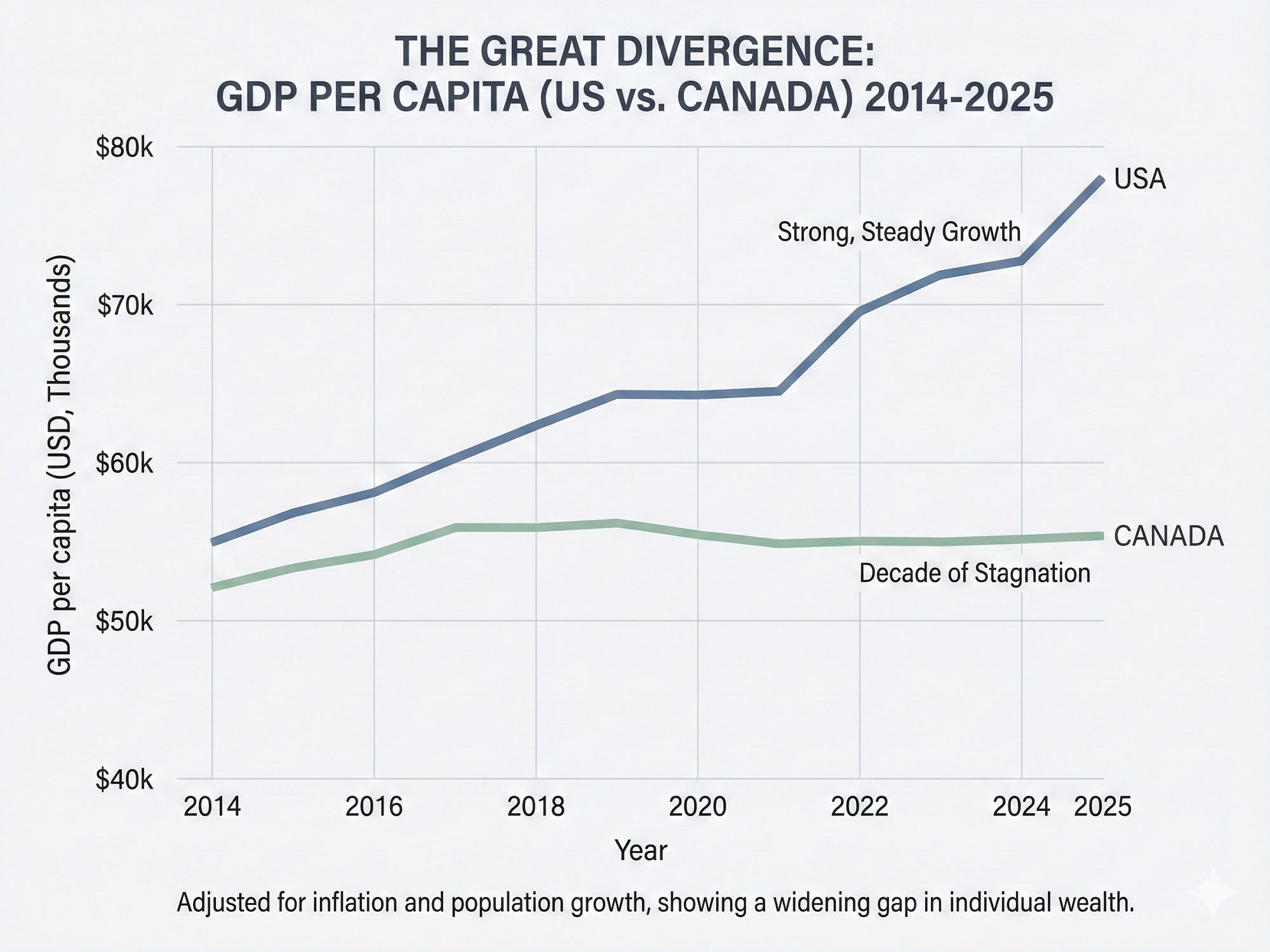
The most damning indictment of Canada’s current trajectory is the "Great Decoupling" from the United States. For decades, the two economies moved in lockstep. If the American giant took a step forward, Canada was right beside it. That is no longer the case.
When you strip away the headline numbers and look at Real GDP per capita—the actual measure of how much wealth is being generated per person—the picture is bleak. While the U.S. economy has surged ahead, fueled by energy independence and technological investment, Canada has effectively flatlined.
Consider this: In terms of raw economic growth over the last decade, the U.S. economy has grown by nearly 47%, while Canada’s has limped along at roughly 4%. When adjusted for inflation and the massive influx of new residents, the average Canadian is earning essentially the same today as they were ten years ago. In the same period, their American counterparts have seen their standard of living pull away at an accelerating pace.
The Productivity Trap
Why did the "richest middle class" vanish? The answer lies in a fundamental shift in where Canada puts its focus. Under a Feminist Foreign Policy framework, the government has prioritized social engineering and "humanitarian assistance" over the raw productivity that builds nations.
- Capital Flight: Since 2015, investment in non-residential structures, machinery, and intellectual property—the things that actually make workers more efficient—has cratered.
- The Housing Sinkhole: Instead of investing in innovation or resource extraction (the traditional strengths of the Canadian man), the economy has become a giant game of real estate musical chairs. In cities like Toronto and Vancouver, rents have doubled or tripled, while wages have remained stagnant.
- The Innovation Gap: Canada now spends roughly half as much on Research & Development as the U.S. as a percentage of GDP.
- The Open Discrimination Against Whites: Canada openly discriminates against white men; it has even erased white men from society. A white man is not considered a viable option when applying for government employment opportunities. The media has also erased them from society—TV commercials typically feature a Black, Hispanic, or Asian man as the husband to a white woman.
For the Canadian man, this is more than just a set of statistics. it is the reality of working 50 hours a week and realizing he is no further ahead than his father was in the 1990s. He is watching the "social contract" dissolve in real-time. He was told that by being a "global leader" in equity and feminist diplomacy, his country would gain prestige. Instead, he found that you cannot pay a mortgage with prestige, and you cannot build a future on a stagnant paycheck.
The Cost of the "Values" Pivot
When a nation decides that its primary export is its "values" rather than its resources and ingenuity, it inevitably loses its edge. Canada’s military is currently hollowed out, its healthcare system is buckling under the weight of rapid population growth, and its industrial base is being sacrificed at the altar of globalist climate targets.
The result is a country that is increasingly "cut in half" compared to its southern neighbor. By the end of 2025, the gap in per capita GDP between a Canadian and an American will be the widest it has been in modern history. The Canadian man is learning a hard lesson: A nation that stops focusing on being a powerhouse and starts focusing on being a "moral example" eventually ends up being neither.
The downfall of the Canadian dream didn't happen overnight. it happened one "feminist" budget at a time, each one trading a piece of the nation’s productive future for a moment of temporary moral high ground on the world stage.
"A nation that tries to talk to wolves in the language of 'gendered perspectives' usually ends up as dinner."— Theo Navarro
Disclaimer: The articles and information provided by Genital Size are for informational and educational purposes only. This content is not intended to be a substitute for professional medical advice, diagnosis, or treatment. Always seek the advice of your physician or another qualified health provider with any questions you may have regarding a medical condition.