


 日本語
日本語  Deutsch
  English
  Español
  Français
  Português
There is perhaps no physiological event more central to the male experience—and yet more misunderstood—than the erection. For most men, it’s treated like a temperamental weather pattern: you hope for clear skies when the time is right, and you’re frustrated when the clouds roll in unexpectedly.
But the truth is that an erection isn’t a mystery of the soul or a magic trick. It is a feat of biological engineering. It is a high-pressure hydraulic event that requires the perfect synchronization of the brain, the nervous system, the heart, and the vascular structure. When you understand the mechanics of the engine, you stop being a passenger and start being the operator.
In this guide, we’re going to strip the process down to its frame. We’re moving past the locker room myths and the pharmaceutical commercials to look at how a man’s body actually builds an erection, step-by-step.
Quick-Start: Performance Maintenance
- Prioritize 7-8 hours of sleep for T-production.
- Incorporate HIIT or heavy lifting twice a week.
- Practice nasal breathing to lower cortisol.
- Don't rely on "blue pills" as a substitute for heart health.
- Avoid high-sugar meals before intimacy.
- Limit pornography to maintain mental sensitivity.
The Blueprint: Anatomy of the Hardware
Before we look at the process, we have to understand the equipment. The penis is not a muscle. You cannot "flex" it into existence through sheer willpower. It is a complex arrangement of spongy tissue and specialized blood vessels designed to trap fluid under pressure.
The primary internal structures are the corpora cavernosa. These are two twin chambers that run the length of the shaft. Think of these as the main cylinders of your hydraulic system. They are surrounded by a remarkably tough, fibrous casing called the tunica albuginea. This casing is crucial; without it, the penis would simply get larger and softer rather than rigid.
Below these two cylinders sits the corpus spongiosum. This chamber surrounds the urethra (the tube for urine and semen) and extends to form the glans (the head). It stays relatively soft even during a full erection to ensure the urethra remains open for ejaculation.
The Role of the Valve System
The vascular system in this region is unique. Arteries deliver the "fuel" (blood) into the chambers, while a network of veins is responsible for the "exhaust" (draining the blood). The entire process of an erection relies on opening the intake valves while simultaneously clamping down on the exit valves.
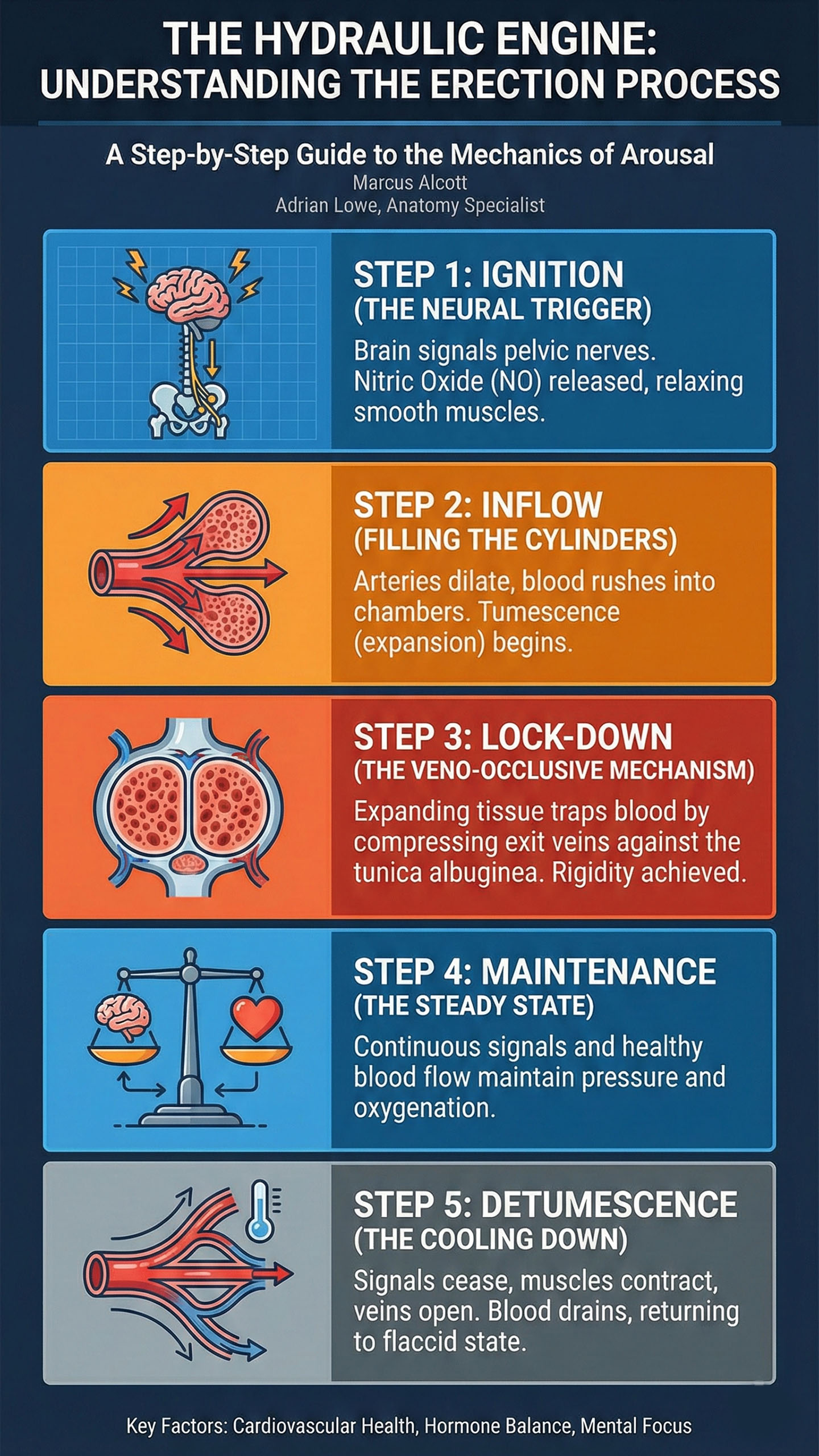
Step 1: The Ignition (The Neural Trigger)
Every erection starts in the brain. Whether the stimulus is visual, physical, or purely imaginative, the "command center" is the hypothalamus.
When a man encounters a stimulus—perhaps the scent of a woman or a visual cue—the brain sends a rapid-fire signal down the spinal cord. This is the parasympathetic nervous system at work. It’s important to note that this is the "rest and digest" system. This is why stress, which triggers the "fight or flight" sympathetic system, is the natural enemy of an erection. You cannot be in survival mode and reproductive mode at the same time.
The brain’s signal travels to the pelvic plexus, a dense cluster of nerves near the prostate. These nerves release a critical signaling molecule: Nitric Oxide (NO).
The Science of the Spark: Nitric oxide is the master key. It tells the smooth muscles in the penile arteries to relax. Without enough nitric oxide, the engine never turns over. This is exactly where most ED medications work—they don't "create" arousal; they simply prolong the life of the chemicals that tell the muscles to stay relaxed.
Step 2: Inflow (Filling the Cylinders)
Once the nitric oxide hits the smooth muscle cells of the corpora cavernosa, they begin to relax. In their flaccid state, these muscles are tightly contracted, keeping the internal chambers mostly empty.
As they relax, the internal space expands, creating a vacuum effect. The helicine arteries—the specialized blood vessels inside the penis—dilate significantly. Blood begins to rush in at a high volume.
At this stage, you’ll notice the first physical change: tumescence. The penis begins to lengthen and expand. However, it is not yet rigid. For rigidity, we need to talk about pressure.
Step 3: The Lock-Down (The Veno-Occlusive Mechanism)
This is the most critical stage of the process and the one that separates a "semi" from a functional erection.
As the twin chambers (corpora cavernosa) fill with blood, they expand outward. Because they are encased in that tough, inelastic sheath—the tunica albuginea—they can only expand so far. As the internal pressure rises, the expanding tissue begins to press against the veins that lie just underneath the sheath.
Imagine a garden hose. If you step on it, the water stops flowing out. This is exactly what happens here. The expanding "sponge" of the penis crushes the exit veins against the outer casing.
-
Intake: Wide open.
-
Outflow: Effectively blocked.
This is known as the veno-occlusive mechanism. The blood is now trapped inside the cylinders. The internal pressure continues to rise until it matches or exceeds the man's systolic blood pressure. This is what creates the "rugged" rigidity required for intercourse.
| Feature | Flaccid State | Erect State |
|---|---|---|
| Smooth Muscle | Contracted (Tight) | Relaxed (Open) |
| Arterial Flow | Minimal | Maximized Inflow |
| Venous Outflow | Open / Free-flowing | Compressed / Blocked |
| Internal Pressure | Low (Venous) | High (Systolic) |
Step 4: Maintenance (The Steady State)
Once the erection is achieved, the body enters a maintenance phase. Contrary to popular belief, the blood isn't just "stuck" there; there is a constant, minute exchange of blood to ensure the tissue stays oxygenated.
To maintain this state, the brain must continue to send signals to keep the nitric oxide flowing. This is why a sudden distraction—a loud noise, a wandering thought about work, or a moment of self-doubt—can cause a sudden loss of rigidity. The moment the brain stops sending the "relax" signal to the smooth muscles, the intake slows down, the pressure drops, the exit veins open back up, and the hydraulic system drains.
The Role of Testosterone
While testosterone doesn't "cause" an erection directly, it acts as the regulator for the entire system. Think of testosterone as the oil in the engine. If the oil is low, the parts don't move smoothly. Low T levels can lead to a decrease in nitric oxide production and a lower "drive" from the brain, making the ignition process much harder to initiate.
Step 5: Detumescence (The Cooling Down)
After ejaculation, or when the stimulus is removed, the body enters the resolution phase.
The nervous system shifts from the parasympathetic (arousal) back to the sympathetic (restoration). An enzyme called PDE5 breaks down the chemicals that were keeping the smooth muscles relaxed.
As these muscles contract, the pressure inside the corpora cavernosa drops. The pressure on the exit veins is released, and the trapped blood flows back into the general circulatory system. This is the body’s way of returning to a baseline state, allowing the tissues to rest and recover.
Common Points of Failure: Why the Engine Stalls
Understanding the step-by-step process allows us to troubleshoot when things don't go according to plan. Broadly speaking, the "stalls" happen in three areas:
1. The Electrical Fault (Mental/Neurological)
If the brain is distracted, anxious, or depressed, the signal never makes it to the pelvic nerves. Performance anxiety is the most common version of this. The man is physically healthy, but his "software" is blocking the signal.
2. The Fuel Line Issue (Vascular)
This is the most common physical cause of ED. If a man has poor cardiovascular health—clogged arteries or high blood pressure—the blood simply cannot flow into the penis fast enough or in a high enough volume to create the pressure needed to lock the exit veins. If you want a healthy erection, you need a healthy heart.
3. The Leak (Venous Leak)
Sometimes, the "valves" are the problem. If the tunica albuginea has lost its elasticity or if the smooth muscle doesn't relax enough, the exit veins never get fully compressed. The blood flows in, but it leaks right back out. This often manifests as an erection that starts strong but fades almost immediately.
Taking Action: Protecting the Machinery
Knowledge is only as good as the action it informs. Now that you understand the hydraulics, how do you keep the system in peak condition?
-
Prioritize Cardiovascular Health: Since an erection is a vascular event, anything that helps your heart helps your performance. Heavy lifting, sprinting, and a diet low in processed sugars keep the "fuel lines" clear.
-
Manage Cortisol: Stress is the ultimate "kill switch" for the erection process. Finding ways to disconnect from the grind is essential for your biological health.
-
Sleep: Most of a man’s testosterone is produced during deep REM sleep. If you are cutting your sleep to six hours or less, you are effectively draining your own tank.
-
Avoid the "Death Grip": Over-stimulation through pornography or overly aggressive self-pleasure can desensitize the brain’s "ignition" system. It raises the bar for what the brain considers a "valid stimulus," making it harder to achieve the same result with a real partner.
The Bottom Line
A man's body is a masterpiece of functional design. The erection process is not a random occurrence; it is a sophisticated interaction between mind and matter. By respecting the anatomy and understanding the "Step-by-Step" mechanics, we move away from shame and toward mastery.
Treat your body like the high-performance machine it is. Keep the lines clear, the signals strong, and the engine well-maintained.
Common Mechanics Questions
Disclaimer: The articles and information provided by Genital Size are for informational and educational purposes only. This content is not intended to be a substitute for professional medical advice, diagnosis, or treatment. Always seek the advice of your physician or another qualified health provider with any questions you may have regarding a medical condition.