


 日本語
日本語  Deutsch
  English
  Español
  Français
  Português
It began as a proposition that was as strategically sound as it was historically precedented. When the United States expressed renewed interest in acquiring Greenland—through dialogue, financial retribution, and ultimately the consent of its people—it was a move rooted in the cold, hard reality of global security.
Any man who understands the concept of protecting his own home understands geography. You don't leave the front gate unlocked when wolves are circling the neighborhood.
Yet, what followed in the capitals of Europe and Ottawa was not a measured discussion among allies. It was a synchronized display of hyperventilation. It was a performative panic that revealed far more about the current state of Western leadership than it did about American intentions.
Suddenly, nations that have relied on American muscle for their very existence for the better part of a century began cataloging the United States as a threat. We heard proclamations from Denmark, backed by a chorus from Germany, France, the UK, and Canada, insisting they would "defend" Greenland. Defend it from whom? The very country that forms the backbone of their own defense alliance?
This reaction is not merely absurd; it is symptomatic of a deeper pathology infecting the political class of the NATO alliance. It is a case study in how an unchecked, collective ideology can override basic strategic thought, turning allies into adversaries in the minds of weak leaders who prefer posturing to reality.
The Arctic Imperative
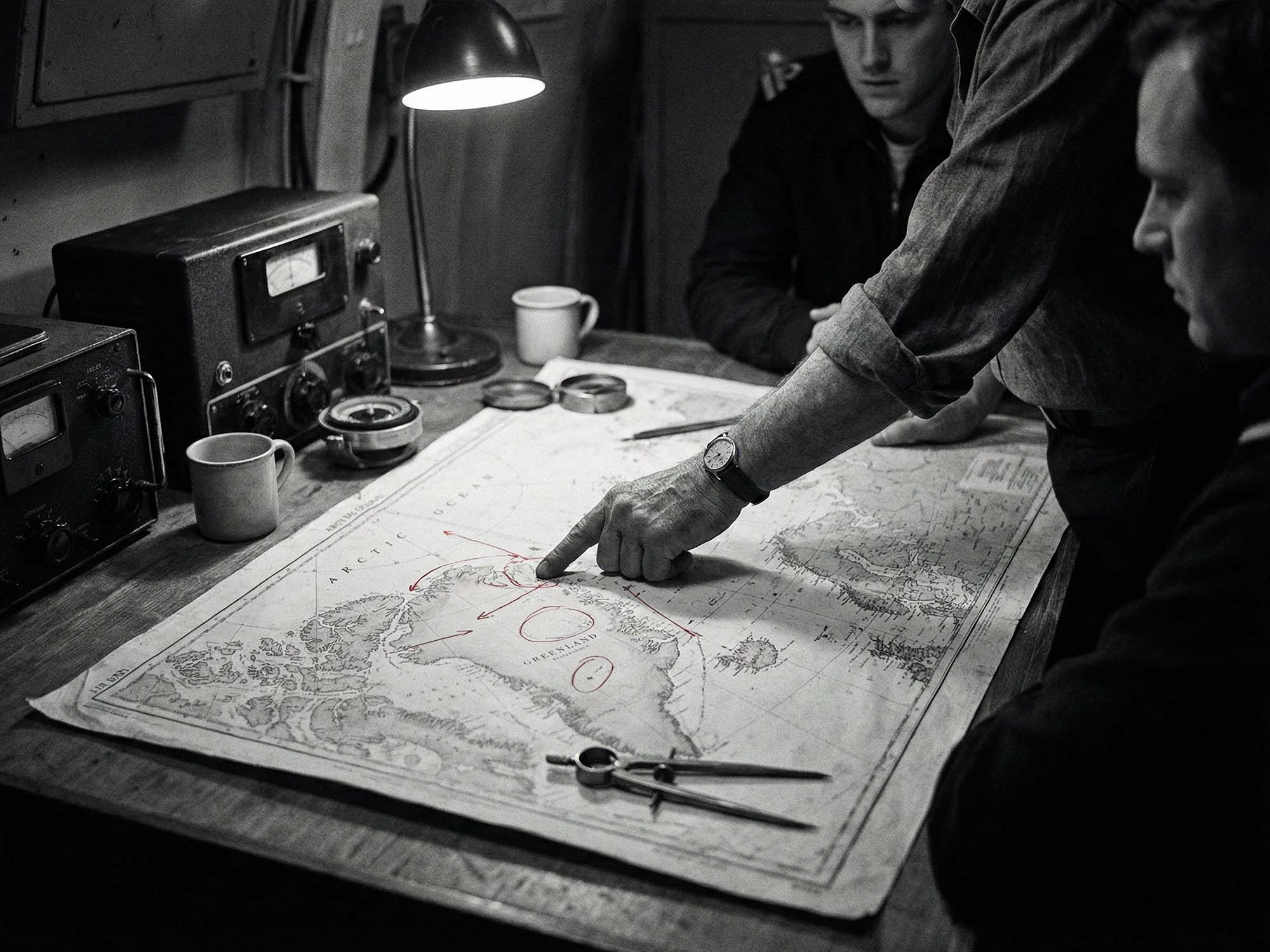
Cultural Insight: The Arctic Man
In Greenlandic and Arctic cultures, survival is predicated on pragmatism and individual competence. Unlike the bureaucratic centers of Europe, life in the North leaves no room for posturing or indecision. To live there is to understand that security is a physical reality, not a rhetorical talking point.
To understand the absurdity of the European reaction, one must first understand the stakes. Greenland is not merely an expanse of ice and rock; it is the strategic cork in the North Atlantic bottle. It sits squarely squarely in the northern approaches to the North American continent.
For decades, American air bases there have been essential for monitoring and deterring threats from the East. Today, as the Arctic ice recedes, opening new shipping lanes and resource frontiers, great power competition has returned to the poles. Russia is aggressively militarizing its northern coast. China, declaring itself a "near-Arctic state," is hungry for access and influence.
In this environment, the security of North America—and by extension, the stability of the free world—requires that Greenland remains firmly within the Western sphere of influence, protected by the only power capable of actually holding that ground: the United States.
The American approach was not an invasion plan. It was a real estate transaction between friends, recognizing that Denmark, a nation of fewer than six million people, lacks the resources to adequately secure a territory three times the size of Texas against encroaching superpowers. The proposal was a recognition of reality. The response, however, was a retreat into fantasy.
The Collective Mindset
The immediate, lockstep condemnation from European leaders like Emmanuel Macron and Canada’s Mark Carney was startling in its uniformity. It was as if a signal had been broadcast on a frequency only audible to the highly progressive ear, causing them all to jump simultaneously.
This is the danger of the prevailing ideology gripping these governments. It is a mindset that abhors individual national interest in favor of a nebulous, supranational collective good that often runs contrary to common sense. In this worldview, the United States, despite being the guarantor of their freedom, is viewed with deep suspicion—a giant that must be tied down by multilateral cords lest it act in its own self-interest.
When one prominent progressive leader expressed outrage, the others felt compelled to join the chorus, fearful of being out-of-step with the herd. They didn't pause to analyze the strategic benefits of a U.S.-secured Greenland for NATO. They reacted emotionally to the perceived arrogance of an America acting like a sovereign nation.
It is a worldview that values consensus over effectiveness, and rhetorical virtue over tangible results. These leaders are comfortable managing decline and attending summits; they are profoundly uncomfortable with decisive action. When faced with a bold move, their instinct is to catalog it as a threat because it disrupts their carefully managed equilibrium of inaction. They are threatening to defend a territory from their own bodyguard, a spectacle that would be comical if the stakes weren't so high.
Glass Houses and Paper Tigers
The spectacle becomes even more galling when one considers the condition of the nations doing the posturing. The idea that the current governments of Germany, France, the UK, or Canada are in any position to "defend" Greenland from the US military is a delusion of staggering proportions.
These are nations whose military readiness has atrophied after decades of underfunding, resting comfortably under the American nuclear umbrella. But more importantly, they are nations currently proving incapable of defending their own borders on their own soil.
Across Europe, a crisis of control is evident. Borders have become suggestions, leading to flood of unvetted immigration that is fundamentally altering the social fabric and security of European cities. We see rising crime rates, the erosion of cultural cohesion, and the formation of parallel societies where national law is secondary.
In the UK with its rape crisis and Canada, governments seem more concerned with policing the speech of their own citizens than securing their physical safety. They expend energy passing laws to curb expression and disarm law-abiding men, while seemingly paralyzed by actual threats to their national integrity.
A man who cannot protect his own front door has no business telling his neighbor how to fix his roof. For these leaders to puff their chests out at the United States while their own houses are in disorder is the ultimate expression of weak men creating hard times. They project strength against a friendly target because they are terrified of confronting the actual dangers facing their societies. It is a performative masculinity adopted by those who lack the genuine article.
Security Perspectives: Realism vs. Collective Ideology
| Strategic Priority | Rugged Realism (US/Meloni) | Collective Ideology (EU/Canada) |
|---|---|---|
| Border Control | Sovereign integrity and physical security first. | Open borders and supranational management. |
| Arctic Strategy | Proactive acquisition to deter Russia/China. | Reactive posturing against allies. |
| Decision Making | Independent, national interest driven. | Consensus-based, "jump when told" herd mentality. |
The Lone Voice of Sanity
Amidst this cacophony of coordinated outrage, it is telling that only one major European leader seemed to keep her head. Italy’s Prime Minister, Giorgia Meloni, notably refrained from joining the hysterical pile-on.
Why? Perhaps because she is a leader less interested in signaling adherence to a progressive groupthink and more interested in the hard realities of national interest and alliance management. She likely recognized the situation for what it was: a strategic discussion between allies that got blown out of proportion by ideologues.
Her silence on the "threat" of America spoke volumes. It demonstrated that the hysteria was a choice, not an inevitability. It showed that it is still possible for a European leader to look at the world without ideological blinders and recognize who their friends actually are.
Re-evaluating the Alliance
The Greenland affair has raised uncomfortable questions about the future of NATO. An alliance is based on shared interests and mutual trust. If key members of that alliance genuinely view the United States' efforts to secure its own hemisphere as a hostile act requiring a "defense," then the foundation of that trust has fractured.
The United States has long born the disproportionate burden of European defense. American taxpayers and American soldiers have guaranteed the peace of a continent that often seems resentful of that very protection.
If Europe wants to treat the US as a potential adversary, perhaps the US should take them at their word. If countries like Canada and Denmark would rather see Greenland become a vulnerability in North America’s armor than see it secured by the United States, they are acting against the security interests of the continent.
The primary duty of any government is to protect its own people. The United States cannot allow vital strategic terrain in its own backyard to be left exposed because European leaders are having an ideological tantrum. If push comes to shove, and the security of North America is genuinely threatened by inaction or obstruction in the Arctic, the United States must be prepared to act alone to secure Greenland.
This is not warmongering; it is the basic responsibility of a provider and protector. If the NATO alliance has become a straitjacket woven from progressive paranoia that prevents the US from defending itself, then the alliance has lost its utility.
Let Europe defend its own eastern flank against Russia. Let them manage their complex relationship with China and the instability in the Middle East without American backing. Perhaps facing the cold winds of geopolitical reality without the American blanket would offer the clarity these leaders desperately need.
Until then, American men should look at the posturing of these allied leaders with a clear eye. We are seeing what happens when societies lose touch with the foundational principles of strength, realism, and self-preservation. We must ensure our own nation does not follow them over that cliff.
Common Sense Check: The Greenland Question
Disclaimer: The articles and information provided by Genital Size are for informational and educational purposes only. This content is not intended to be a substitute for professional medical advice, diagnosis, or treatment. Always seek the advice of your physician or another qualified health provider with any questions you may have regarding a medical condition.