



 日本語
日本語  Deutsch
  English
  Español
  Français
  Português

There is a specific kind of silence that settles over a group of men when the conversation shifts toward the measurable. Whether it’s the number on a barbell, the figure on a paycheck, or the inches on a measuring tape, we live in a world governed by metrics. We are a sex built for competition and comparison; it is wired into our biology to want to know where we stand in the hierarchy.
But lately, something has shifted. The data that used to serve as a benchmark for self-improvement has been weaponized by a culture that thrives on insecurity. We are living in an era where "average" is treated like a terminal diagnosis, and the statistics meant to describe us are instead being used to shame us. When culture distorts male body data, it doesn’t just change how we see ourselves—it changes how we show up in the world.
The Tyranny of the Mean
In mathematics, the "mean" is simply a central value of a set of numbers. In culture, however, the "average" has become a dirty word. If you look at the metrics often discussed in men’s health—testosterone levels, height, and genital dimensions—there is a massive disconnect between scientific reality and social expectation.
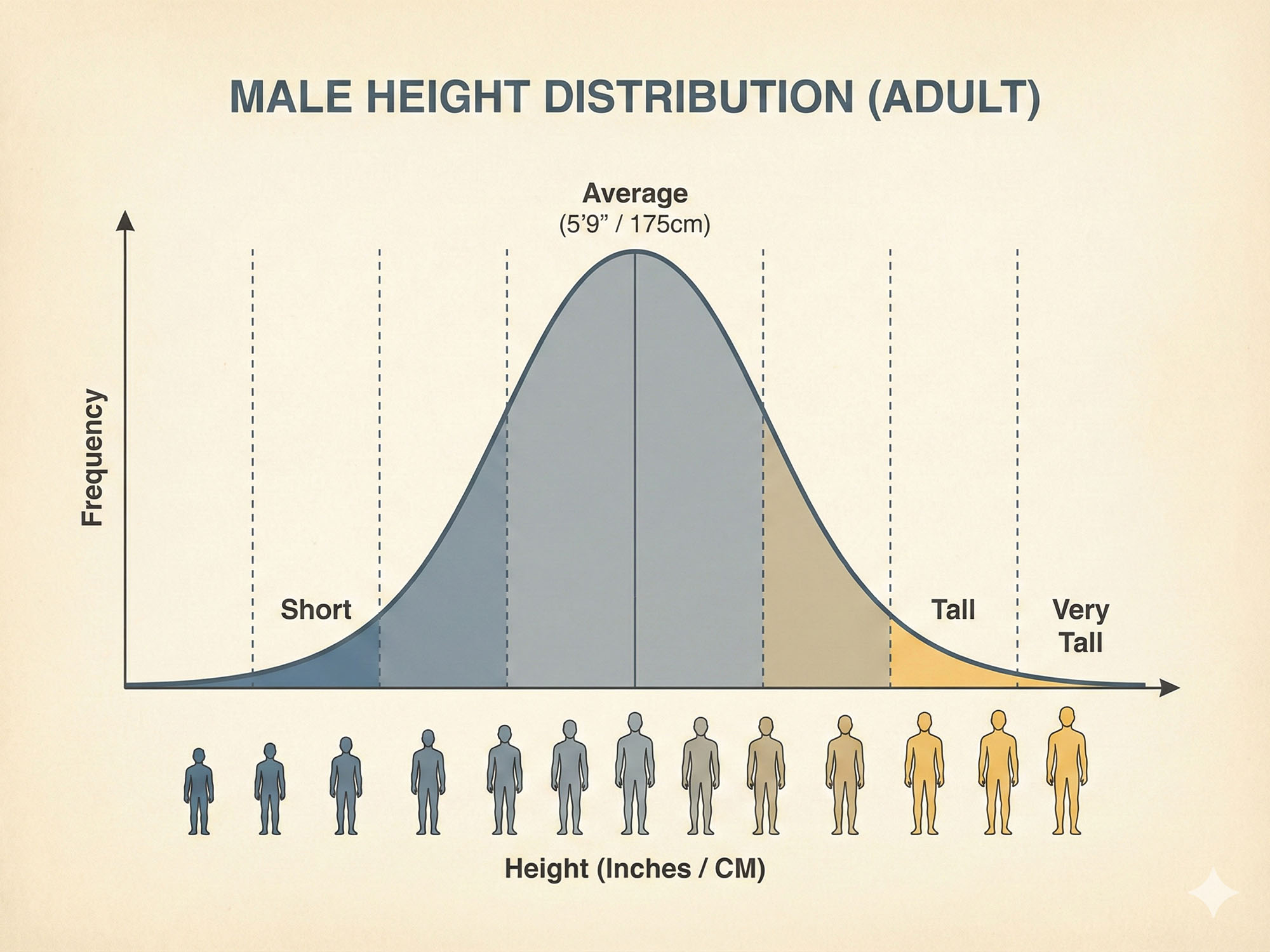
Take height, for example. In the United States, the average height for a man is approximately 5'9". Yet, if you spend ten minutes on any social media platform or dating app, you would be led to believe that any man under 6'0" is practically invisible. This isn’t just a preference; it’s a statistical distortion. By making 6'0" the baseline for "acceptable," culture effectively disenfranchises 80% of the male population.
When we look at testosterone, the distortion is even more clinical. We see "normal ranges" that have been steadily declining for decades. A man in his 30s today often has the hormone profile of a man in his 60s from two generations ago. Instead of addressing the environmental and lifestyle factors causing this, the culture either ignores it or treats the resulting symptoms—fatigue, brain fog, loss of drive—as a moral failing. We are told to "man up" while the very biological fuel required to do so is being siphoned away.
The Perception Gap
How digital culture inflates the "standard" vs. what clinical data actually shows.
| Metric | The "Internet Standard" | Clinical Reality |
|---|---|---|
| Height (US) | 6'0"+ (Top 15%) | 5'9" (Median) |
| Body Fat | 6-8% (Unsustainable) | 12-18% (Healthy/Athletic) |
| Genital Size | Skewed by Self-Report | 5.1 - 5.9 inches (Average) |
The Digital Funnel of Insecurity
The primary culprit in this distortion is the digital landscape. Algorithms do not care about accuracy; they care about engagement. And nothing drives engagement like a cocktail of envy and inadequacy.
When a man logs onto a fitness forum or a "lifestyle" page, he isn't met with the reality of the human form. He is met with the top 0.1%. He see men who are chemically enhanced, professionally lit, and dehydrated to the point of vascularity that is unsustainable for more than a few hours. These outliers are presented as the standard.
When the outlier becomes the expectation, the average man looks in the mirror and sees a failure. This is where the shame takes root. It’s a quiet, corrosive feeling that tells a man his natural state is insufficient. This is particularly prevalent in the realm of male anatomy. For years, "data" regarding genital size has been skewed by self-reporting bias—men who are larger are more likely to volunteer for studies, and men who are smaller tend to exaggerate their measurements.
When actual, clinical measurements are taken by objective professionals, the numbers are consistently lower than the "internet average." Yet, the internet average is what men compare themselves to in the dark of their own rooms. This gap between the "digital truth" and the "biological truth" is where the modern male psyche goes to die.
The Architecture of the Male Body
To understand why this distortion is so damaging, we have to look at the architecture of the male body and the psychology of performance. A man’s sense of self is often tied to his utility—his ability to provide, protect, and perform. When statistics suggest he is "sub-par," it strikes at the core of his identity.
The culture often frames these insecurities as "fragile masculinity." This is a reductive and lazy critique. It isn't "fragile" to care about your standing or your physical capabilities; it is foundational. When we tell men that their concerns about their bodies are just "ego," we ignore the biological reality that physical status has mattered for the entirety of human history.
The problem isn't the desire to be "more"; the problem is that the goalposts have been moved to a stadium that doesn't exist. We are being asked to compete against filtered images and exaggerated data points.
Jonas's Performance Note: The T-Level Trap
"Modern labs often set the 'normal' range for testosterone between 300 and 1,000 ng/dL. However, culture ignores that a 30-year-old at 350 ng/dL may feel like a ghost of himself compared to his grandfather at the same age. Don't chase a number on a lab sheet; chase the resolution of symptoms through lifestyle first."
The Performance Trap
This distortion leads directly into what I call the "Performance Trap." This is the cycle where men seek out shortcuts—often dangerous ones—to meet the distorted statistical "norm."
We see this in the explosion of "TRT Clinics" that operate more like pill mills than medical facilities. While testosterone replacement therapy is a legitimate and life-changing treatment for men with clinical deficiencies, it is increasingly being marketed to young men who are simply chasing a statistical ideal.
We see it in the rise of body dysmorphia and the "bigorexia" prevalent in weightlifting communities. Men are chasing a level of muscularity that the human frame was never meant to carry naturally. They are chasing a number on a scale or a body fat percentage that is often incompatible with long-term health or reproductive function.
Even in the bedroom, the data distortion creates a performance anxiety that is reaching epidemic proportions among younger men. When pornographic "statistics" (which are effectively stunts) become the benchmark for reality, the natural, healthy function of a man’s body is viewed as inadequate.
Reclaiming the Reality of the Male Form
So, how do we push back against the shame? How do we return to a grounded understanding of our own biology?
It starts with an uncompromising look at the hard data—not the "influencer" data, but the clinical reality. We need to normalize the "normal."
-
Height: 5'9" is the center of the curve. It is the height of some of the most influential, powerful, and athletic men in history.
-
Strength: Being able to move your own body weight and maintain a functional level of lean muscle puts you ahead of the vast majority of the modern population.
-
Anatomy: The vast majority of women report that "average" is not only sufficient but often preferred for actual comfort and connection. The "statistical outliers" touted online are rarely what translates to a healthy, long-term relationship.
We also have to stop the "self-report" culture. If you are getting your health advice or your "averages" from a guy selling a supplement or a course, the data is compromised. Period.
The Role of Women and Relationships
It would be remiss to discuss male body shame without mentioning the role of women. There is a strange paradox in modern dating: women, quite rightly, pushed back against the impossible beauty standards placed upon them for decades. However, as the pressure on women has slightly eased in some sectors, the pressure on men has intensified.
The "6-6-6" rule (6 feet tall, 6-pack abs, 6-figure salary) is a meme, but it’s a meme rooted in a very real cultural shift. When women—and society at large—validate these distorted statistics, it reinforces the idea that a man’s value is purely a collection of high-percentile metrics.
However, the reality on the ground is often different. In real-world relationships, most women are looking for stability, character, and a man who is comfortable in his own skin. The irony is that the pursuit of these distorted statistics often makes a man less attractive because it breeds a frantic, underlying insecurity. Nothing is less masculine than a man who is constantly checking his reflection in the digital eyes of strangers.
The Path Forward: Mastery Over Measurement
The antidote to statistical shame is mastery. Instead of focusing on where you sit on a curve that might be rigged, focus on the objective improvement of your own machine.
A man who can run a mile in under seven minutes, squat twice his body weight, and look his neighbor in the eye doesn't need to worry about whether he’s 5'10" or 6'1". He has developed a physical and mental competency that transcends the "mean."
We need to move away from the "body positivity" movements that demand we lie to ourselves and instead move toward a "body reality" movement. This means acknowledging that while we may not all be elite athletes or genetic outliers, we have a duty to maximize what we were given.
The "shame" comes from the gap between what you are and what you could be. It should not come from the gap between what you are and a manufactured digital lie.
Ending the Silence
Finally, we need to start talking about this with more honesty. Men are notoriously bad at discussing their insecurities, fearing it makes them look "weak." But there is a difference between whining and an analytical assessment of a cultural problem.
When we keep these insecurities to ourselves, they fester. They drive us toward isolation, toward pornography, and toward a cynical view of the world. When we bring them into the light—when we realize that the "average" man next to us is feeling the exact same pressure to be an "outlier"—the power of the distortion fades.
The data should be a tool for us, not a cage. We are more than the sum of our measurements. We are the builders, the providers, and the backbone of our communities. It is time we stopped letting a distorted digital culture tell us that the very body that allows us to do those things isn't enough.
The statistics aren't the problem. The shame is the problem. And the cure for shame is truth. The truth is that you are likely exactly where you need to be—now, get to work on being the best version of that man.