



 日本語
日本語  Deutsch
  English
  Español
  Français
  Português
Most men don’t fail in the gym because they’re lazy. They fail because they’re grinding in the wrong direction.
They show up. They sweat. They punish themselves with brutal workouts and leave feeling wrecked—yet months later, strength stalls, joints ache, and results stay stubbornly average. The problem isn’t effort. It’s misdirected effort.
The modern gym culture pushes intensity over intelligence. More plates, more volume, more days, more pain. That mindset sounds tough, but it quietly sabotages progress. Muscle doesn’t grow from chaos. Strength doesn’t come from ego. And longevity sure as hell doesn’t come from ignoring basic physiology.
Below are seven common gym mistakes that don’t just slow you down—they actively work against you. Fix these, and training starts paying you back instead of charging interest on future injuries.
Quick-Start: Train Smarter This Week
- Do: Track lifts and recovery
- Do: Sleep 7–9 hours
- Don’t: Train to failure daily
- Don’t: Ignore joint pain
1. Training Like Every Session Is a War
There’s a belief among men that every workout needs to feel like a near-death experience. If you’re not crawling out of the gym, it “doesn’t count.”
That’s nonsense.
Training is not combat. It’s construction. And you don’t build a house by smashing the foundation every day.
When every session turns into max-effort lifting, failure sets, and forced reps, recovery never catches up. Cortisol stays high. Testosterone response drops. Joints take a beating. Sleep quality suffers. Progress slows even though effort increases.
Hard training works when it’s planned. Not when it’s constant.
Elite lifters don’t chase exhaustion—they chase adaptation. That means:
-
Heavy days balanced with moderate and lighter days
-
Leaving 1–3 reps in reserve on most sets
-
Treating deloads as part of the program, not a sign of weakness
If you feel destroyed after every workout, that’s not discipline. That’s poor management.
Fix it: Train hard on purpose, not by habit. Save true all-out sessions for planned phases, not daily therapy sessions with iron.
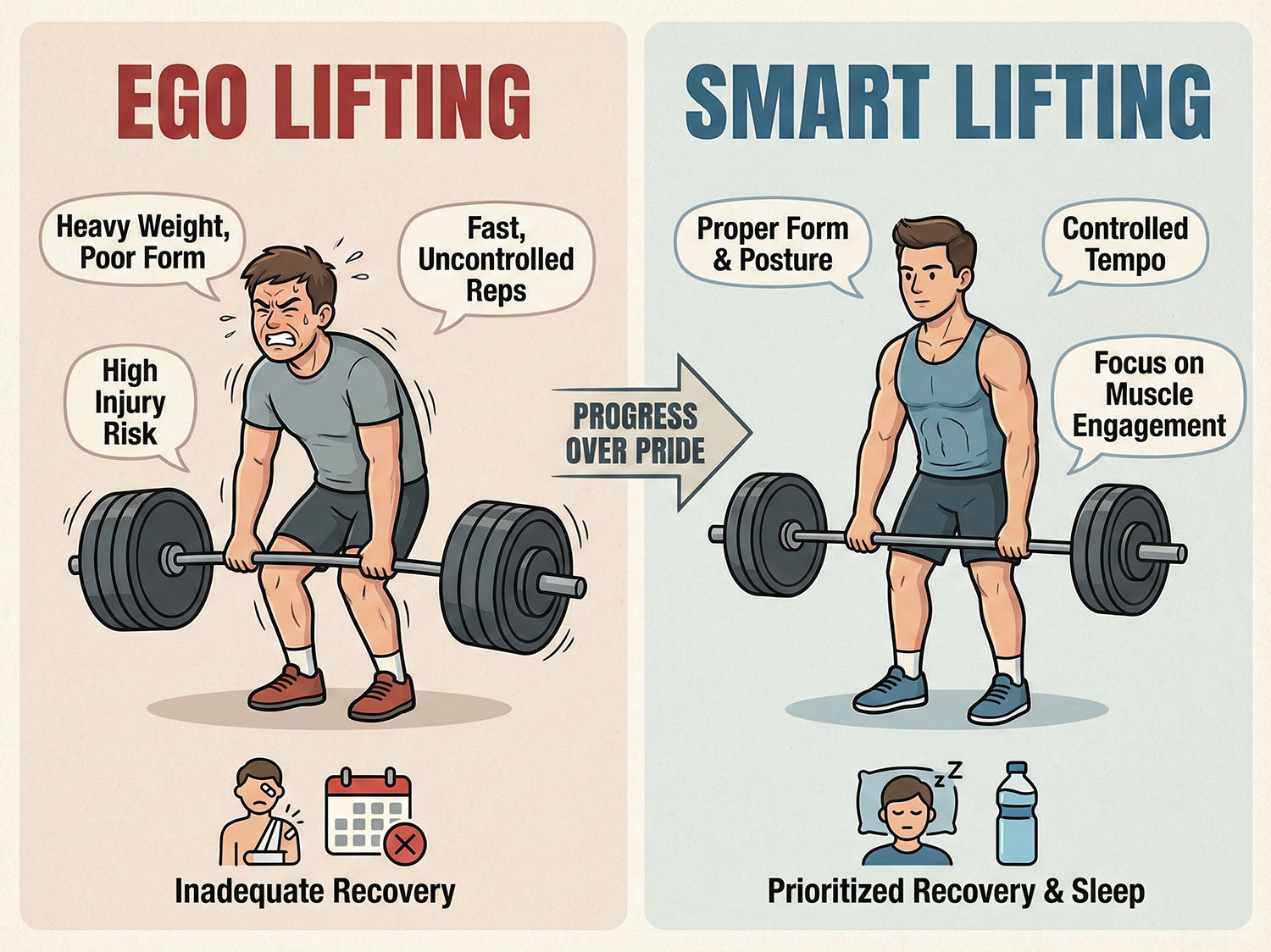
2. Letting Ego Choose the Weight
Ego lifting is the silent killer of progress.
It looks like half squats loaded like a powerlifting meet. Bench presses bounced off the chest. Deadlifts yanked with rounded backs and prayers instead of bracing.
Sure, the weight looks impressive. But muscles respond to tension, not bravado.
When form breaks down, the target muscle stops doing the work. Smaller stabilizers take over. Joints absorb stress they were never designed to handle. Over time, nagging pain turns into chronic limitation.
Strength built on shortcuts is fragile. Strength built on control lasts.
Good training asks:
-
Can you control the eccentric?
-
Can you pause briefly where the muscle is weakest?
-
Can you own the last rep without shaking apart?
If not, the weight owns you.
Fix it: Drop the load. Slow the reps. Earn the right to lift heavy instead of auditioning for attention.
3. Ignoring Recovery Like It’s Optional
Muscle isn’t built in the gym. It’s built afterward—when you eat, sleep, and let the nervous system calm down.
Yet recovery is treated like a soft suggestion instead of a hard requirement.
Men will train six days a week, sleep five hours a night, eat randomly, and wonder why libido drops, motivation fades, and joints feel ancient at 32.
That’s not aging. That’s mismanagement.
Chronic under-recovery leads to:
-
Elevated cortisol
-
Suppressed testosterone
-
Reduced insulin sensitivity
-
Slower protein synthesis
-
Higher injury risk
You don’t get bonus points for ignoring biology.
Fix it:
-
Sleep 7–9 hours consistently
-
Eat enough calories to match training demands
-
Take rest days without guilt
-
Treat mobility work and light cardio as tools, not chores
Recovery isn’t weakness. It’s strategy.
“Strength isn’t built through chaos. It’s built through consistency, recovery, and respect for the body.”
4. Training Without a Plan (or Progression)
Wandering into the gym and “seeing what feels good” works for about three weeks. After that, progress stalls.
Muscle and strength respond to progressive overload—a gradual increase in stress over time. Without structure, the body adapts once, then coasts.
Random workouts feel productive but rarely are.
A solid program answers three questions:
-
What am I improving this week?
-
How does this workout connect to last week?
-
What am I backing off to allow growth?
Without those answers, you’re just exercising—not training.
Fix it:
Follow a program that tracks:
-
Volume
-
Load
-
Frequency
-
Recovery weeks
Consistency beats novelty every time.
5. Neglecting Lower Body and Posterior Chain
Some men train legs like an afterthought. A few machine sets, rushed squats, then back to arms.
That’s a mistake with consequences.
The posterior chain—glutes, hamstrings, spinal erectors—is a major driver of:
-
Overall strength
-
Athletic power
-
Hormonal response
-
Injury prevention
Strong legs support heavy upper-body lifts. They stabilize the spine. They protect the knees and lower back. They even influence confidence and posture.
Skipping leg training isn’t saving time. It’s limiting your ceiling.
Fix it:
Prioritize compound lower-body lifts:
-
Squats (or variations)
-
Deadlifts or hinges
-
Lunges and split squats
Train legs with intent, not avoidance.
6. Confusing Pain With Progress
There’s a difference between productive discomfort and warning signals.
Sharp joint pain. Persistent tendon aches. Numbness. Loss of range of motion. These aren’t badges of honor. They’re early messages.
Ignoring pain doesn’t make you tough—it makes you unavailable to train later.
Many men push through injuries out of pride, only to end up sidelined for months. A short-term ego boost turns into long-term regression.
Fix it:
-
Address pain early
-
Modify movements instead of forcing them
-
Strengthen weak links rather than masking symptoms
-
Get professional input when needed
Longevity is a performance advantage.
7. Training for Looks Instead of Function
Chasing aesthetics alone creates imbalance.
Endless chest and arm work paired with weak backs, hips, and core leads to poor posture, shoulder issues, and reduced performance. The body becomes decorative rather than capable.
Strength should transfer. It should make daily movement easier, not harder.
A capable physique:
-
Moves well
-
Stabilizes under load
-
Generates force efficiently
-
Resists injury
That kind of body still looks strong—but it’s built on function first.
Fix it:
Balance your training:
-
Push and pull evenly
-
Train rotation and anti-rotation
-
Strengthen grip, core, and hips
A body that works well tends to look the part anyway.
Common Gym Mistakes vs Smarter Fixes
| Mistake | Why It Backfires | Smarter Approach |
|---|---|---|
| Training to failure daily | Raises cortisol, limits recovery | Leave 1–3 reps in reserve |
| Ego lifting | Joint strain, poor muscle tension | Control tempo and range |
| Skipping recovery | Hormonal suppression | Sleep, nutrition, deloads |
Gym Training Questions Men Ask
In Brief
Most gym mistakes aren’t about laziness—they’re about misdirected effort. Fixing recovery, structure, and technique unlocks long-term strength.
The Smarter Way Forward
Real strength isn’t loud. It’s quiet consistency stacked over years.
Men who train well aren’t the ones limping out of the gym every night. They’re the ones who show up year after year, steadily adding weight, muscle, and resilience.
The goal isn’t punishment. It’s progress.
Fix these seven mistakes and training becomes simpler, more effective, and far more sustainable. You’ll lift better, recover faster, and keep your edge long after others burn out.
Strength is earned—but it’s also managed.
Disclaimer: The articles and information provided by Genital Size are for informational and educational purposes only. This content is not intended to be a substitute for professional medical advice, diagnosis, or treatment. Always seek the advice of your physician or another qualified health provider with any questions you may have regarding a medical condition.