


 日本語
日本語  Deutsch
  English
  Español
  Français
  Português
The Birth of an Ideal
Before mirrors and muscle magazines, men saw themselves reflected in myth.
In ancient Greece, the male form was not merely a vessel of strength — it was an expression of harmony, proportion, and restraint. The statues of gods like Apollo and athletes like Doryphoros represented balance rather than bulk.
To the Greeks, beauty lay in symmetry, not size. The sculpted torso and measured musculature reflected an ideal of mind over matter — a body governed by discipline and intellect.
The Romans, inheriting Greek aesthetics, added their own vision: power. A soldier’s build became an emblem of control and command. The ideal male form was now both aesthetic and authoritative — a symbol of a man’s place in society and empire.
Centuries later, during the Renaissance, that ideal resurfaced, filtered through Christian morality and humanist philosophy. Artists like Michelangelo rendered the male nude as a divine form — sensual yet spiritual, mortal yet godlike. David stood not as a warrior but as a symbol of human perfection: vulnerable, poised, and strong without excess.
“Every era chisels its vision of manhood in flesh and stone; only the tools change.” — Elena Mireau
Shifting Shapes in the Modern Age
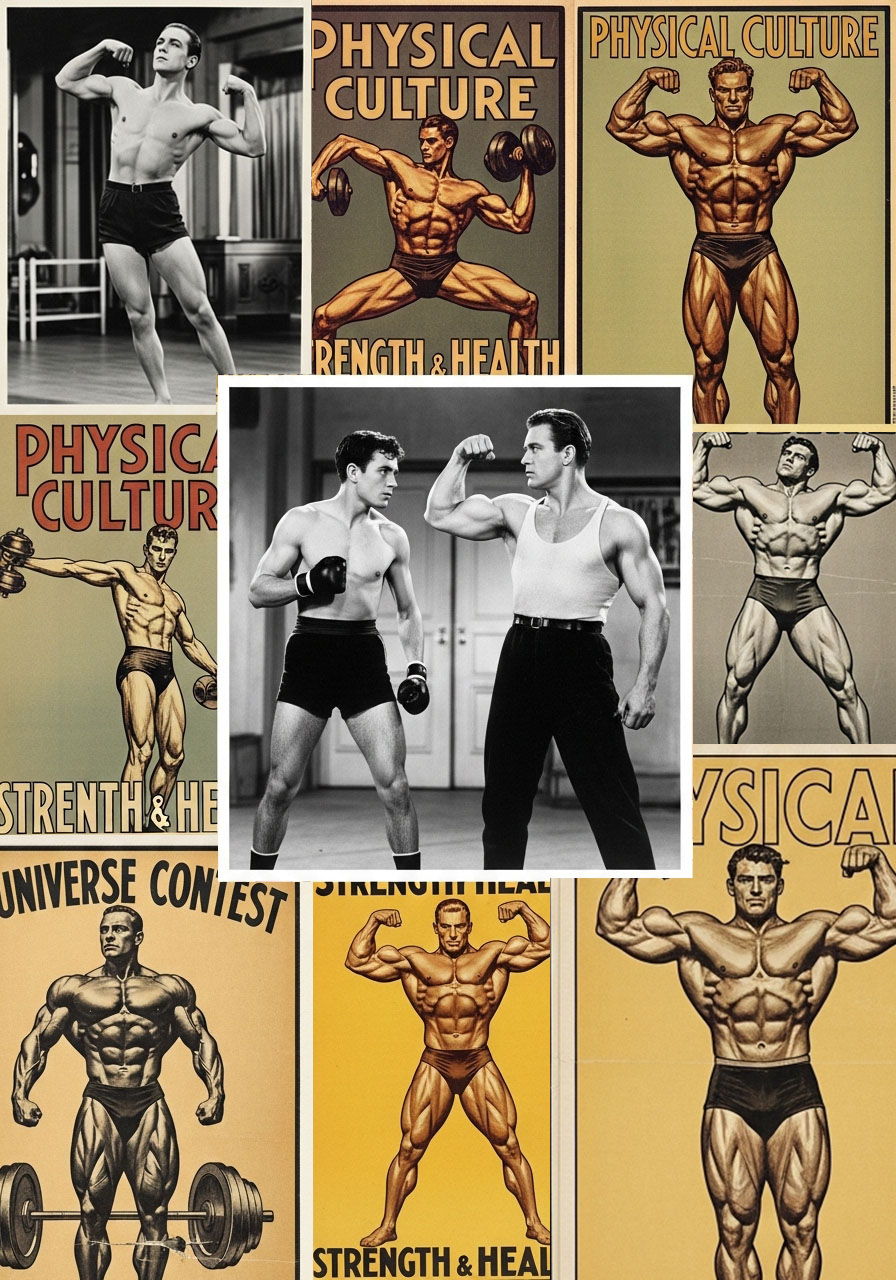
By the late 19th century, ideals began to industrialize. Men no longer worked the land or fought wars with swords; their strength became symbolic rather than necessary. Early physical culture — the forerunner of bodybuilding — promised to restore vigor to men softened by modern life. Figures like Eugen Sandow transformed muscle into spectacle, blending classical aesthetics with the emerging notion of masculine self-improvement.
Then came Hollywood.
From the silver screen to streaming platforms, media turned the male body into both an aspiration and a product. The post-war decades gave rise to icons like Marlon Brando, Sean Connery, and Steve McQueen — rugged, lean, and quietly confident. They were not yet defined by abs, but by attitude.
By the 1980s, the ideal had changed again — pumped, tanned, and hyper-visible. The Schwarzenegger era celebrated exaggerated masculinity: strength as dominance, not balance. Muscles became a uniform, a signal that a man’s worth could be measured in mass.
Media Mirrors and Modern Pressure
Today, the male body is both more visible and more scrutinized than ever before.
Fitness influencers, film franchises, and social media filters have constructed a new visual grammar of masculinity — one that demands constant proof of effort and endurance. Men, once spectators of beauty, are now participants in it, subject to the same aesthetic pressures long placed upon women.
Studies show that body dissatisfaction among men has risen sharply in recent decades, often linked to unrealistic portrayals of physiques in advertising, entertainment, and pornography. The “ideal” man now appears to be perpetually lean, muscular, and effortlessly confident — a fantasy sustained by lighting, editing, and enhancement.
What was once myth has become marketing.
The male body is no longer a symbol of civic virtue or divine proportion — it’s a consumer category, carefully optimized for engagement.
Changing Ideals by Era — Quick Reference
| Era | Ideal | Signal |
|---|---|---|
| Ancient Greece | Symmetry, restraint, proportion | Reason, discipline |
| Rome | Athletic power, authority | Civic order, command |
| Renaissance | Poised strength, sensual-spiritual balance | Human perfection |
| Early 20th c. | Physical culture, spectacle | Vigor, self-improvement |
| 1950s–60s | Lean, rugged, controlled | Attitude over abs |
| 1980s | Hyper-muscular, tanned, maximal | Dominance, spectacle |
| Today | Lean-muscular, camera-ready | Algorithmic visibility |
Changing Ideals by Era — Quick Reference
| Era | Ideal | Signal |
|---|---|---|
| Ancient Greece | Symmetry, restraint, proportion | Reason, discipline |
| Rome | Athletic power, authority | Civic order, command |
| Renaissance | Poised strength, sensual–spiritual balance | Human perfection |
| Early 20th c. | Physical culture, spectacle | Vigor, self-improvement |
| 1950s–60s | Lean, rugged, controlled | Attitude over abs |
| 1980s | Hyper-muscular, tanned, maximal | Dominance, spectacle |
| Today | Lean-muscular, camera-ready | Algorithmic visibility |
Between Strength and Sensitivity
But the story is not entirely one of loss.
Cultural expectations may have narrowed, but personal narratives have widened. Men today are beginning to question what strength should look like — and who gets to define it. Strength is being reimagined as more than resistance training; it includes emotional steadiness, self-awareness, and physical health over pure aesthetics.
In truth, the ideal male body has always been an echo of the times.
From the disciplined balance of the Greeks to the algorithmic perfection of the influencer age, it reflects what society values — reason, control, virility, or visibility. Each era sculpts its own myth of manhood.
What remains constant is the search — not for perfection, but for meaning within the form.
Questions Men Ask
In Brief
- Ancient ideals favored symmetry and restraint.
- 20th-century media turned muscle into a market signal.
- Today’s pressures are visual—and often edited.
Did You Know?
The word “gymnasium” comes from the Greek gymnós, meaning “naked”—a reminder that athletic training and the viewed male body were historically intertwined.
Disclaimer: The articles and information provided by Genital Size are for informational and educational purposes only. This content is not intended to be a substitute for professional medical advice, diagnosis, or treatment. Always seek the advice of your physician or another qualified health provider with any questions you may have regarding a medical condition.